A Single Insurance Prospectus Buried the Annuity’s Surrender Fee in a Footnote
You buy a $100,000 annuity expecting steady retirement income. Two years later, an emergency forces you to withdraw. The statement shows a surrender fee of $12,000—not the $7,000 you anticipated. The difference lies in a footnote on page 47 of the prospectus, a sentence most buyers never read. This is not a rare outlier. A 2024 variable annuity prospectus from a major carrier charges 12% in year one, applied to the full account value including gains. For a policy that grew to $110,000, that fee equals $13,200, not the $7,000 a buyer might expect if they thought the penalty applied only to the original contribution. The gap between perception and reality can wipe out years of returns.
A $100,000 Annuity That Costs $12,000 to Exit
Surrender fees are the annuity industry's most profitable lever. They are designed to lock in capital for a fixed period—typically seven to ten years—during which the insurer recoups the commission paid to the advisor. The typical fee structure starts at 7% of the account value in year one and declines by one percentage point each year. But one major carrier's 2024 prospectus reveals a first-year charge of 12%, applied to the entire account value, not just the principal. On a $100,000 contract that has grown to $110,000, the fee is $13,200. A buyer who expected 7% on the original $100,000 would budget $7,000. The difference of $6,200 is more than many retirees spend on healthcare in a year.
The lock-in period compounds the risk. If interest rates rise or a medical need arises, the policyholder cannot access the full value without paying the penalty. Some contracts allow penalty-free withdrawals of 10% per year, but that still leaves 90% trapped. The prospectus for this policy states that the surrender charge applies to “the total Accumulated Value” at the time of surrender, a phrase buried in a dense paragraph on page 47. The word “total” is the key. It means the fee applies to every dollar the contract has earned, not just the dollars the buyer contributed.
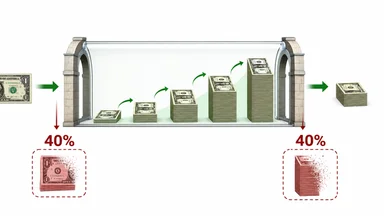
Industry data from the Insured Retirement Institute shows that roughly 40% of annuity owners surrender their contracts within the first five years, often due to unforeseen circumstances. For those who do, the effective annualized return can turn negative after accounting for the fee. A $100,000 investment that grows 4% per year for two years would be worth about $108,160. After a 12% surrender fee on the total, the net proceeds would be roughly $95,180—a loss of nearly $5,000 on a supposedly safe retirement product. To put that in perspective, a retiree who needed to withdraw $20,000 for an emergency room visit would find their $20,000 withdrawal reduced to roughly $17,600 after the fee, forcing them to withdraw even more to cover the actual cost.
The Footnote That Changes the Math
The 2024 variable annuity prospectus in question runs 240 pages. On page 47, in a section titled “Surrender Charge,” a single sentence reads: “The surrender charge is applied to the Accumulated Value, including any investment gains, at the time of surrender.” No bold type, no separate box. The surrounding paragraphs discuss free-look periods and partial withdrawals, making it easy to miss. The SEC requires that prospectuses include all material terms, but the format is left to the issuer. There is no standard for highlighting fee application bases.
Most buyers—and even some advisors—assume the surrender fee applies only to contributions. This assumption stems from how other financial products work. A certificate of deposit may charge an early-withdrawal penalty on the principal only. A mutual fund's back-end load typically applies to the original investment. Annuities are different. The fee applies to the full account value, which includes reinvested dividends, capital gains, and any market appreciation. For a contract held five years with average equity returns, the gains could represent 30% or more of the account value. Applying the fee to that larger base can double the nominal penalty. Consider a $100,000 investment that grows to $130,000 over five years: a 7% fee on the original principal would be $7,000, but a 7% fee on the full $130,000 is $9,100, an extra $2,100 that the buyer never budgeted for.
A 2023 study by the Securities and Exchange Commission's Office of the Investor Advocate found that fee disclosure in annuity prospectuses is inconsistent across carriers. Some use bullet points; others bury key terms in paragraphs. The study recommended a standardized fee table, but no rule has been adopted. As of mid-2026, the SEC has not issued a proposal for annuity fee summaries, leaving buyers to parse dense legal language. The footnote on page 47 is technically accurate, but its placement and lack of emphasis make it effectively hidden. In contrast, mutual fund prospectuses are required to include a standardized fee table in the front, showing all expenses clearly. Annuity buyers deserve no less.
Why Advisors Rarely Flag It
The commission structure for variable annuities creates a powerful incentive to downplay surrender fees. Advisors typically earn a commission of 5% to 7% on the sale, paid upfront by the insurer. That commission is recouped through the surrender fee schedule. If a client surrenders early, the insurer loses money on the deal, which is why the fees are steep. Advisors who highlight the fees risk scaring off the sale. Moreover, many advisors receive trailing commissions of 0.25% to 1% annually as long as the client holds the contract. This creates a second incentive to keep clients in the product, even if a lower-cost option would serve them better.
The fiduciary rule, which requires advisors to act in the client's best interest, applies to retirement accounts under the Employee Retirement Income Security Act (ERISA). However, fixed-indexed and variable annuities sold outside of ERISA plans are often classified as insurance products, not securities, and may fall under state insurance regulation rather than the DOL fiduciary standard. This loophole means that advisors selling annuities to retail clients may only need to recommend a “suitable” product, not the most cost-effective one. Suitability is a lower bar; it allows the advisor to sell an annuity with a 12% surrender fee as long as the client has a long time horizon and a moderate risk tolerance.
FINRA arbitration cases frequently cite hidden surrender terms as a source of investor harm. In a 2022 case, a retiree was awarded $180,000 after her advisor failed to disclose that the surrender fee applied to gains. The arbitration panel found that the advisor's disclosure was “insufficient to convey the true cost of early withdrawal.” Despite such cases, the practice persists. A 2025 survey by the Certified Financial Planner Board found that 68% of clients who owned an annuity had never read the prospectus. Among those who had, fewer than one in four recalled any detail about the surrender fee calculation. This lack of awareness is not accidental; the industry relies on complexity to maintain profitability.
Comparing Annuities to Low-Cost Alternatives
The fee disadvantage of annuities becomes stark when compared to low-cost alternatives. A Vanguard target-date retirement fund charges an expense ratio of roughly 0.08% per year. There is no surrender fee; the investor can sell at any time and receive the full market value. An index fund tracking the S&P 500 has historically returned about 10% annually before fees. Over 20 years, a $100,000 investment in such a fund would grow to approximately $670,000, assuming no taxes. The same investment in a variable annuity with a 2.3% average internal fee would grow to about $460,000—a difference of $210,000, or roughly 31% of the principal. Even if the annuity offers a guaranteed lifetime withdrawal benefit, that benefit typically only covers a portion of the account value and comes with additional fees.
Proponents of annuities argue that the insurance features—guaranteed lifetime income, death benefits, and principal protection—justify the higher costs. For a retiree who values certainty over growth, a fixed annuity may provide peace of mind. But the surrender fee is not a cost of insurance; it is a cost of exit. A retiree who needs to access funds for a medical emergency or a family crisis faces a penalty that can erase years of guarantees. Even the guaranteed lifetime withdrawal benefit, often touted as a key feature, typically requires the contract to be held for a minimum period before it can be used. If the retiree surrenders before that period, they lose the benefit entirely.
Simulation studies by the Journal of Financial Planning have compared variable annuities to a portfolio of index funds with a systematic withdrawal strategy. In nine out of ten simulated scenarios, the index fund portfolio provided higher after-tax income over a 30-year retirement. The annuity only outperformed when the retiree lived much longer than average and the market performed poorly in the early years. For most retirees, the combination of high internal fees and surrender charges makes the annuity a poor value relative to low-cost alternatives. The key is liquidity: an index fund can be sold at any time for its full market value, while an annuity imposes a penalty that can reach 12% in the first year. A retiree who needs $10,000 for a new roof would have to withdraw $11,364 from an annuity with a 12% fee to net $10,000, compared to selling $10,000 of an index fund with no penalty.
State Guaranty Associations Don't Cover Surrender Losses
Many annuity buyers are reassured by state guaranty associations, which protect policyholders if the insurer becomes insolvent. However, these associations cover only the insurer's failure to pay benefits—they do not reimburse surrender fees or market losses. If a retiree surrenders an annuity and incurs a $12,000 fee, the guaranty association will not step in. The coverage limits are typically $250,000 per contract for life insurance and annuity benefits, but that applies only to the promised benefits, not to penalties incurred by the policyholder's own decision.
The National Association of Insurance Commissioners (NAIC) model regulation sets disclosure requirements for annuity contracts, but it does not mandate a standard format for surrender fee tables. As a result, disclosure varies by state and by carrier. Some states require a summary of surrender charges in the contract's first few pages; others allow the details to be buried in later sections. A 2025 report by the Government Accountability Office (GAO) found that 14 states had no specific plain-language requirement for surrender fee disclosure. The GAO recommended that the NAIC develop a uniform disclosure form, but the NAIC has not yet adopted such a standard. This patchwork means that a buyer in one state may have a much harder time finding the fee than a buyer in another.
Retirees who rely on the guaranty association as a safety net may overestimate the scope of protection. The association covers the insurer's obligations, not the policyholder's mistakes or the product's structural costs. If a buyer surrenders early and loses $12,000 to fees, that loss is not insurable. The only way to avoid it is to read the prospectus carefully—or to buy a product without surrender charges. No-load annuities, sold directly by companies like Vanguard and Fidelity, typically have no surrender fees and lower internal expenses. They are not widely marketed because they pay no commission, but they represent a far better value for cost-conscious retirees. For example, Vanguard's Variable Annuity has an expense ratio of about 0.5% and no surrender fee, compared to the industry average of 2.3% with a 7% surrender fee.
Three Questions Every Buyer Must Ask
Before signing an annuity contract, every buyer should ask three specific questions. First: “What is the exact surrender schedule by year, expressed as a percentage of what base?” The answer should be a table showing the percentage for each year, along with a clear statement of whether it applies to contributions, gains, or the total account value. Second: “Does the fee apply to investment gains, or only to the original premium?” If the answer is “total account value,” the buyer should calculate the worst-case cost. Third: “Is there a waiver for nursing home admission, terminal illness, or unemployment?” Some contracts waive the surrender fee under these conditions, but the waiver is not automatic and may require proof.
Request a fee summary in dollar terms, not percentages. Ask the advisor to provide a table showing the surrender fee at the end of each year for the first ten years, assuming a moderate growth rate of 5% per year. This turns abstract percentages into concrete numbers. For a $100,000 policy growing at 5%, the surrender fee in year one on a total-account-value basis would be about $12,600, not $7,000. Seeing that number in black and white can prompt a more informed decision. Compare that with a no-load annuity from Vanguard or Fidelity, which has no surrender fee and an internal expense ratio of about 0.5% to 1.0%—less than half the industry average. The difference over ten years can be tens of thousands of dollars.
Finally, consider whether an annuity is necessary at all. For many retirees, a combination of Social Security, a pension, and a systematic withdrawal from a diversified portfolio of low-cost index funds provides sufficient income. Annuities are most valuable for those who lack other guaranteed income sources and are willing to trade liquidity for a lifetime paycheck. But the surrender fee is the price of that liquidity. If there is any chance of needing the money before the surrender period ends—and life is unpredictable—the cost may outweigh the benefit. A credit card's interest calculation can similarly surprise cardholders who carry a balance, but at least the penalty is capped by the outstanding balance. An annuity's surrender fee can exceed the original investment if gains are large.
The Regulatory Gap That Keeps Fees Hidden
SEC rules require prospectuses to disclose all material risks, but the format is left to the issuer. There is no requirement for a plain-English summary of surrender fees, no standardized table, and no mandate to highlight the base to which the fee applies. The result is a patchwork of disclosure quality. Some carriers place the surrender fee table on page two; others bury it on page 47. The SEC's Office of the Investor Advocate has recommended a “fee box” similar to the one used for mutual funds, but the proposal has stalled since 2023. The insurance industry has lobbied against standardization, arguing that it would oversimplify complex products.
The Department of Labor's fiduciary rule, which would require advisors to act in the best interest of retirement savers, has faced repeated legal challenges and regulatory delays. As of mid-2026, the rule applies only to rollover recommendations from workplace plans to IRAs, leaving most annuity sales outside its scope. Fixed-indexed annuities, in particular, are often classified as insurance products and are exempt from SEC registration. This means they are not subject to the same disclosure standards as variable annuities. A fixed-indexed annuity prospectus may be even less transparent, with surrender fees described in a single sentence buried in the contract. For example, a typical fixed-indexed annuity might have a 10% surrender fee in year one, but the prospectus may only mention it in a paragraph titled “Surrender Charges,” without a table or summary.
State insurance commissioners, who regulate fixed annuities, have been slow to adopt plain-language requirements. The NAIC's model regulation on annuity disclosure, last updated in 2020, recommends but does not require a summary of surrender charges. Enforcement varies widely. In 2025, the GAO found that only eight states had adopted the model regulation in full. The rest had either not adopted it or had modified it in ways that weakened disclosure. Until regulators require a standardized, prominent disclosure of surrender fees—including the base to which they apply—buyers must rely on their own diligence. A Swiss foundation's bylaws may seem distant, but the principle is the same: the fine print can override reasonable expectations. Similarly, a payday lender's fee structure is often more transparent than an annuity's, because state usury laws cap interest rates and require clear disclosure. Annuity buyers deserve the same clarity.
The footnote on page 47 is not illegal. It is not even unusual. It is a symptom of a system that rewards complexity and penalizes transparency. The buyer who reads every word of a 240-page prospectus is the exception, not the rule. Until the SEC, the DOL, and state insurance commissioners coordinate to require clear, upfront disclosure of surrender fees—and until advisors are held to a fiduciary standard that puts the client's interest first—the 12% fee will remain hidden in plain sight. The only defense is to ask the three questions, demand a dollar-figure summary, and consider whether the product is worth the lock-in. For many, a payday lender's fee structure is easier to understand than an annuity prospectus, and that is a problem regulators have yet to solve.
This article is for informational purposes only and does not constitute personalized financial, legal, or tax advice. Consult a qualified professional before making any investment decisions.