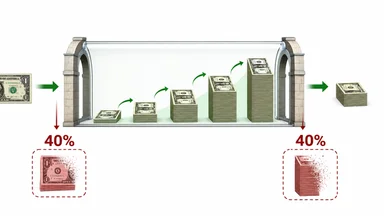
Your Annuity Contract Deducts a Fee on Every Premium Dollar Before It Accumulates
Annuity contracts are sold as safe havens for retirement savings, promising guaranteed income and tax deferral. But the fine print reveals a different story: every premium dollar you hand over gets trimmed before it starts to grow. The fees are not hidden—they are disclosed in documents few read—but their cumulative effect can cut your nest egg by a third or more over two decades. This article walks through the actual cost layers, the contract provisions that trap your money, and the trade-offs that make annuities either a sensible choice or a very expensive mistake.
The Fee You Never See Is the One That Costs the Most
The first deduction on any annuity premium is the premium load, a sales charge that typically runs between 5% and 10% of each dollar you contribute. If you put in $10,000, only $9,000 to $9,500 actually enters the accumulation account. This load is rarely negotiable and is often highest in the early years of the contract. Some insurers waive it for very large contributions, but most retail buyers pay the full freight.
On top of the premium load comes the mortality and expense risk charge, or M&E fee. This covers the insurer's cost of guaranteeing the death benefit and covering its own overhead. M&E fees vary by product but typically range from 1% to 1.5% of the account value annually. Unlike the premium load, which is a one-time hit, the M&E fee recurs every year for the life of the contract. Over a 20-year holding period, that can eat up roughly 20% of your account's growth.
Administrative fees are a third layer, deducted either as a flat annual charge—often $30 to $50—or as a percentage of assets. Some contracts combine both. These fees cover recordkeeping, statement generation, and customer service. They are small relative to other charges, but they compound over time. A $40 annual fee on a $50,000 account reduces the net return by 0.08% per year, which adds up when combined with other layers.
Sales commissions are the fourth and most opaque cost. Agents typically earn commissions of 5% to 10% of the premium, and these costs are recovered through the contract's surrender schedule and higher ongoing fees. The commission is not listed as a separate line item; it is built into the product's expense structure. As of late 2024, some variable annuity prospectuses disclosed total annual expenses exceeding 3%, of which roughly a third went to distribution costs.
Rider costs inflate the total expense ratio further. Common riders include guaranteed minimum income benefits, long-term care coverage, and death benefit enhancements. Each rider adds 0.5% to 1.5% per year to the asset-based fee. A contract with three riders can easily have a total expense ratio above 4.5%. Many buyers do not realize that riders are optional—and that they can be dropped, though often only after a waiting period.
How the Accumulation Phase Quietly Drains Your Principal
During the accumulation phase, your first dollars buy the agent's commission, not your future income. In a typical variable annuity, the insurer deducts the premium load immediately, then invests the remainder in subaccounts that resemble mutual funds. But before any market return is credited, the M&E fee and administrative charges are taken. If the subaccount earns 7% in a year and total fees are 3%, your net return is 4%—and that 4% compounds on a smaller base because of the initial load.
Surrender schedules lock you into the contract for seven to ten years, sometimes longer. If you need to withdraw more than the free amount—usually 10% per year—you pay a surrender penalty that starts at 7% to 10% of the withdrawal and declines gradually. This penalty exists precisely because the insurer front-loaded the commission. A 2023 study by the Insured Retirement Institute found that roughly one in five annuity owners surrendered within the first five years, incurring penalties that averaged 6% of account value. Early withdrawals can wipe out years of gains, so it is critical to plan for liquidity needs before signing.
Market gains inside a variable annuity are taxed as ordinary income upon withdrawal, not as capital gains. This is a critical distinction from taxable brokerage accounts, where long-term gains get preferential rates. For someone in the 24% federal bracket, the difference between a 15% capital gains rate and a 24% ordinary rate on a $100,000 gain is $9,000 in extra tax. The tax deferral benefit is real, but it only helps if your tax bracket in retirement is lower than during accumulation—and that is not guaranteed.
Annuities do not receive a step-up in basis at death. When you pass away, your heirs inherit the contract at its cost basis—the total premiums paid, not the current account value. If the account has grown, they owe ordinary income tax on the gains. By contrast, stocks and mutual funds in a taxable account get a step-up to the date-of-death value, wiping out the capital gains tax. This difference can be significant for estate planning.
Fixed-indexed annuities, which credit returns based on a stock market index, often cap gains at 4% to 6% per year while guaranteeing no loss of principal. But the cap means you miss out on strong years. In 2021, the S&P 500 returned 28.7%; a fixed-indexed annuity with a 5% cap would have credited only 5%. Over the long term, these products tend to underperform a simple low-cost balanced fund, especially after fees. Inflation can further erode the purchasing power of the fixed credits.
The Fine Print on Withdrawal Mechanics Few Read
Most annuities allow a free withdrawal of up to 10% of the account value per year without penalty. This provision is meant to give you access to a small portion of your money. But the free withdrawal is usually calculated on the prior year's anniversary value, not the current value. If your account grows, the free amount increases; if it shrinks, so does your access. And if you skip a year, the unused free amount does not roll over. This design means you cannot accumulate multiple years of free withdrawal capacity—use it or lose it each year.
Withdrawals beyond the free window trigger a surrender penalty that varies by contract year. A typical schedule might impose a 7% penalty in year one, declining by one percentage point each year until it reaches zero in year eight. Some contracts use a "contingent deferred sales charge" that applies to any withdrawal, not just full surrenders. The penalty is calculated on the amount withdrawn, not on the gain, so you can lose principal even if the account has not grown. For example, if you invested $100,000 and the account value drops to $90,000, a $10,000 withdrawal could still incur a $700 penalty, leaving you with only $9,300.
Income riders, which guarantee a lifetime payout, recalculate the benefit base annually. The benefit base is a notional amount used to determine your guaranteed income; it is not the same as your account value. Each year, the benefit base may increase by a fixed percentage—say 5%—or by the account's growth, whichever is higher. But the rider fee is deducted from the account value, not the benefit base. If the account value declines due to fees and poor markets, the rider may still promise a high income, but the underlying account may be insufficient to sustain it if you later decide to surrender.
Required minimum distributions (RMDs) apply to annuities held inside qualified retirement accounts, such as IRAs and 401(k)s. Starting at age 73, you must withdraw a certain percentage each year based on the IRS life expectancy tables. If your annuity has a surrender penalty, you may be forced to take a taxable withdrawal that incurs that penalty. Some contracts allow you to take RMDs without penalty, but not all do. Check the contract language carefully.
Death benefits are another area where fine print matters. Most variable annuities offer a death benefit equal to the greater of the account value or total premiums paid, less any withdrawals. But the benefit is paid to the beneficiary as a lump sum, which may be subject to probate if no beneficiary is named. Some contracts allow the beneficiary to stretch the payments over their life expectancy, but that option is less common now. The death benefit is not free; it is funded by the M&E fee, which you pay every year regardless of whether you die.
Comparing Annuity Fees to Other Retirement Vehicles
The average expense ratio for a 401(k) plan is roughly 0.5% per year, according to a 2024 study by BrightScope. That covers investment management, recordkeeping, and administrative services. An IRA invested in an S&P 500 index fund can have an expense ratio below 0.1%. By contrast, a variable annuity's total annual costs—including M&E, administrative, and rider fees—often exceed 3% per year. That difference of 2.5 percentage points compounds dramatically over time.
Consider a $100,000 investment earning a gross 6% annual return over 20 years. At a 0.1% fee, the ending value is roughly $310,000. At a 3% fee, it is about $179,000—a difference of $131,000. The annuity loses 42% of the low-cost portfolio's value to fees. This simple calculation ignores the premium load, which would further widen the gap. Even if the annuity provides tax deferral, the fee drag is hard to overcome unless you are in a very high tax bracket now and expect a much lower one in retirement.
Tax deferral inside an annuity means you do not pay taxes on dividends, interest, or capital gains until withdrawal. In a taxable account, you pay taxes each year on dividends and realized gains. But the benefit of deferral is diminished if you hold the annuity for a long time, because the eventual withdrawals are taxed as ordinary income. For a buy-and-hold investor in index funds, the tax cost of a taxable account can be as low as 0.3% to 0.5% per year, far less than the annuity's extra fees.
Annuity returns rarely beat low-cost index funds over long periods. A 2022 study by the Insured Retirement Institute found that the average variable annuity returned about 2.8% annually after fees over the prior decade, compared to 12.6% for the S&P 500. Even accounting for the fact that many annuity investors choose conservative subaccounts, the fee burden is a major factor. Fixed-indexed annuities have performed even worse, with average crediting rates around 3% to 4% in recent years, well below inflation-adjusted equity returns.
Regulatory Safeguards and Their Limits
Annuities are regulated by both the Securities and Exchange Commission (SEC) and state insurance departments. Variable annuities are securities, so they must register with the SEC and provide a prospectus. Fixed and indexed annuities are insurance products, regulated solely by state insurance commissioners. The dual regulatory structure creates gaps: variable annuity prospectuses disclose fees in detail, but fixed annuity contracts are often less transparent. State insurance departments rarely review fee levels for reasonableness.
Suitability standards require that agents recommend products appropriate for the customer's financial situation, age, and risk tolerance. Since 2020, the SEC's Regulation Best Interest has applied to broker-dealers selling variable annuities, requiring them to act in the customer's best interest. But the rule does not impose a fiduciary duty—agents can still recommend higher-cost products as long as they disclose conflicts. A 2023 survey by the Consumer Federation of America found that over 60% of annuity recommendations from commissioned agents were for products with above-average fees.
Most states do not impose a fiduciary duty on insurance agents selling fixed annuities. The National Association of Insurance Commissioners has a model suitability regulation, but adoption varies. In practice, an agent can recommend a high-cost fixed-indexed annuity to a 70-year-old retiree with a low risk tolerance, even if a low-cost immediate annuity would be cheaper. The agent's commission is often the deciding factor.
Consumer complaints about annuities frequently cite misleading illustrations. Sales materials often project returns based on the gross crediting rate, not the net rate after fees. A fixed-indexed annuity might show a 6% hypothetical return, but after the cap, spread, and fees, the actual credited rate may be 3% or less. State insurance departments handle complaints, but enforcement is uneven. The SEC has brought cases against firms for misleading marketing, but the number of actions is small relative to the size of the market.
Practical Steps Before You Sign a Contract
Before buying any annuity, request a fee table that shows total dollar costs for a sample investment amount over a 10-year period. The SEC requires variable annuity prospectuses to include a fee table, but fixed annuities are not subject to the same rule. Ask the agent to write down all charges—premium load, M&E, administrative, rider fees, and surrender penalties—and then ask for the total expense ratio as a percentage of account value. If the agent cannot provide it, that is a red flag.
Compare the annuity's net return after all fees with a low-cost alternative, such as a target-date fund inside an IRA. Use an online calculator to project the difference over your expected holding period. The results can be sobering. For example, a $200,000 investment in an annuity with 3.5% annual fees versus a 0.15% index fund over 25 years can mean a difference of over $400,000 in ending value, assuming 7% gross returns.
Review the surrender schedule and free-withdrawal limits carefully. If you think you might need access to more than 10% of the account in any given year, an annuity is likely a poor fit. Also check whether the free withdrawal is cumulative over the life of the contract or resets annually. Some contracts allow you to take a lump-sum free withdrawal at the start, but then you lose that ability for the rest of the year.
Evaluate each rider's necessity. A guaranteed lifetime withdrawal benefit may sound appealing, but it typically adds 1% per year in fees. If you are healthy and have other retirement income, you may not need it. Long-term care riders can be valuable, but they are expensive and often have limited benefit periods. Ask for a separate quote for the base contract without riders, and compare the net income projections. Many riders are sold as peace of mind but end up reducing total wealth.
Finally, ask for the total expense ratio in writing. If the agent hesitates, consider that a warning. A reputable agent should be able to provide a one-page summary of all costs. If you are still interested, take the contract to a fee-only financial planner who can run an independent analysis. The upfront cost of a planner's hourly fee is small compared to the lifetime cost of a poorly chosen annuity.
The Trade-Offs: Guaranteed Income vs. High Costs
For retirees who prioritize guaranteed lifetime income above all else, an immediate annuity—or a deferred annuity with an income rider—can provide a predictable paycheck that cannot be outlived. This is the product's core value proposition. For someone with no pension and a modest Social Security benefit, the certainty of a monthly check may justify the fees. The trade-off is that you give up control of the principal, and inflation erodes the purchasing power of fixed payments. Over a 30-year retirement, a fixed annuity payment that starts at $1,000 per month may have the purchasing power of only $500 after 20 years at 3.5% inflation.
Hybrid annuities that combine long-term care coverage with an income stream can be useful for those who cannot qualify for stand-alone long-term care insurance. These products allow you to access a portion of the death benefit to pay for care if needed. The fees are high, but they may be lower than the combination of a separate annuity and a long-term care policy. However, the benefit pools are often capped, and unused benefits may not pass to heirs. For example, a typical hybrid annuity might offer a long-term care benefit pool equal to two to three times the premium, but if you never need care, that extra coverage is lost.
Tax deferral can be valuable for investors who have already maxed out their 401(k) and IRA contributions and are in a high tax bracket. An annuity inside a taxable account allows the money to grow without current taxation. But the benefit is only realized if you stay in a lower bracket in retirement. For someone earning $400,000 per year now and expecting $100,000 in retirement, the deferral can be worth several thousand dollars annually. Even then, low-cost municipal bonds or index funds may be more efficient. A 2021 analysis by Morningstar found that for most investors in the 24% tax bracket, the tax deferral of an annuity was worth less than 0.5% per year in additional return, far less than the typical fee differential.
Principal protection in fixed-indexed annuities appeals to risk-averse investors who cannot stomach market losses. The guarantee that your account value will never decline, even if the market drops, is real. But the cost is the cap on upside and the fees. Over long periods, inflation risk may be greater than market risk. A 3% fixed credit on a $100,000 annuity yields $3,000 per year, which loses purchasing power if inflation runs at 3% or higher. In contrast, a diversified portfolio of 60% stocks and 40% bonds has historically returned about 8% to 10% annually, far outpacing inflation, albeit with volatility.
Legacy planning with a death benefit rider can ensure that beneficiaries receive at least the amount of premiums paid, even if markets decline. This can be useful for someone who wants to leave a specific dollar amount to heirs. But the rider fee reduces the account value, so the net benefit may be less than if the money were invested in a low-cost taxable account with a step-up in basis. As always, the trade-off is between certainty and cost. For instance, a $200,000 annuity with a 1% death benefit rider fee over 20 years could cost over $40,000 in fees, potentially more than the step-up benefit it provides.
The decision to buy an annuity ultimately hinges on whether the guaranteed income and other features are worth the high fees and lost flexibility. For most investors, the answer is no—low-cost index funds and a systematic withdrawal strategy can provide similar income with lower costs and greater control. But for a minority, especially those with specific longevity or long-term care concerns, an annuity may fill a gap that other products cannot. The key is to go in with eyes open, understand every cost, and compare it to the alternatives. A fee-only financial planner can help you model the trade-offs without the conflict of a commission.
Disclaimer: This article is for informational and educational purposes only and does not constitute personalized financial, legal, or tax advice. Consult a qualified professional before making any investment decisions.