What Your Mortgage’s Prepayment Clause Actually Says About Penalty Windows
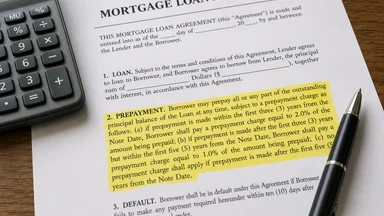
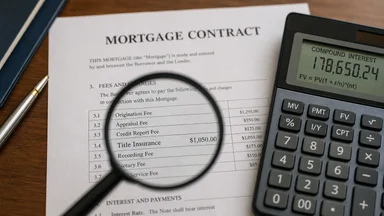
When you sign a mortgage, the prepayment clause is easy to overlook. Buried near the end of a stack of documents, it often reads like boilerplate: "Borrower may prepay the loan in whole or in part, subject to a prepayment penalty as set forth herein." That sentence, however, defines a timer that can cost you thousands of dollars if you refinance, sell your home, or even make an extra payment during the first few years. Understanding what that clause actually says—and what it doesn't—is essential for anyone who wants to keep control of their biggest financial obligation.
The Prepayment Clause Is Not a Trap—It's a Timer
A standard prepayment clause defines a penalty window that typically runs two to five years from the date of closing. That window does not start when you make your first payment; it starts the day the loan funds. If you pay off the entire balance or make a substantial extra payment during that period, the lender charges a fee. The penalty is often calculated as a percentage of the outstanding balance—commonly 3 to 6 months' interest—or as a flat fee that declines over time.
Many contracts use a sliding scale: 5% of the balance in year one, 4% in year two, 3% in year three, and then zero. Others tie the penalty to the interest rate differential (IRD)—the difference between your contract rate and the current market rate—multiplied by the remaining term. The IRD method can produce a much larger penalty when rates have dropped significantly, which is precisely when refinancing becomes attractive.
After the penalty window closes, prepayment is free. You can pay off the entire loan, make extra principal payments, or sell the home without incurring any penalty. The clause is not designed to punish you forever; it is a timer that aligns with the lender's own financial exposure.
Some borrowers assume the penalty only applies to a full payoff, but many clauses also apply to partial prepayments above a certain threshold—say, 20% of the original principal in a given year. Making an extra $500 payment every month could trigger the penalty if the total exceeds that threshold. Always read the "Prepayment" section of your note, not the "Fees" clause, which may list only servicing charges.
Why Lenders Insert the Window—The Haircut Logic
Lenders do not originate mortgages with their own deposits. They borrow money from wholesale markets—often through repurchase agreements, or repos—to fund the loans. When you prepay early, the lender must replace that asset with a new loan at a lower yield, or repay its own borrowing before maturity. That mismatch creates a loss, and the prepayment penalty is designed to cover it.
The concept is similar to a haircut in finance. As the Bank of England's Money Market Committee noted in its June 2026 minutes, repo markets rely on collateral that can be liquidated quickly at a predictable value. A mortgage is less liquid than government bonds, so lenders apply a larger haircut when valuing it. The prepayment penalty effectively passes that haircut to the borrower if the loan is terminated early.
Interest rate risk is the core issue. If a lender issued a 30-year fixed-rate loan at 6% and you prepay after two years, the lender must reinvest the returned principal at the current market rate—say, 4%. Over the remaining 28 years, that 2% shortfall compounds into a real loss. The penalty window protects the lender's yield, not as a punishment but as a hedge against reinvestment risk.
Critics argue that the penalty is excessive because the lender can often replace the loan quickly. But in a declining rate environment, the lender may not have enough new borrowers at the old higher rate to offset the loss. The clause is a negotiated risk allocation, not a trap. Understanding this logic can help you negotiate better terms or choose a lender with a shorter window.
Three Contract Variations That Shift Your Risk
Not all prepayment clauses are the same. The three most common variations are fixed-rate loans with an IRD-based penalty, adjustable-rate loans with a flat fee, and government-backed loans with limited or no penalty. Each shifts risk differently.
For fixed-rate loans, the penalty is often based on the interest rate differential. For example, if your loan balance is $300,000, your rate is 6%, and the current rate for a similar term is 4%, the IRD might be calculated as (6% - 4%) × remaining years × balance. That could easily exceed $10,000. Some contracts use a simpler method: 3 to 6 months of interest. In the same example, 6 months of interest at 6% on $300,000 is $9,000—still substantial but less volatile.
Adjustable-rate loans (ARMs) typically use a flat fee, such as 1% or 2% of the outstanding balance, or a fixed dollar amount. Because ARM rates reset periodically, the lender's reinvestment risk is lower, so the penalty is smaller. However, some ARM contracts include a "no-call" period during which prepayment is prohibited entirely. Check the terms carefully.
Loans insured by the Federal Housing Administration (FHA) or guaranteed by the Department of Veterans Affairs (VA) often have no prepayment penalty after the first year. Some state laws, such as California Civil Code Section 2954.9, restrict prepayment penalties on loans under a certain amount. A few states, including New York and Texas, ban them entirely for certain loan types. Always check your state law before signing.
The Refinance Trigger: How Rate Drops Activate the Window
When market interest rates drop by 1% or more, refinancing becomes an obvious move. But if you are still inside the penalty window, the prepayment fee can wipe out a significant portion of your savings. Consider a $300,000 loan refinanced at the end of year two, with a penalty equal to 4% of the balance: that is $12,000. Add closing costs of $5,000, and your total upfront cost is $17,000. If the new rate saves you $200 per month, it would take more than seven years to break even—longer than many borrowers stay in the home.
The actual penalty depends on your exact contract terms. Some lenders use a declining percentage scale; others use IRD. A borrower with a 5% rate who refinances into a 4% rate after two years might face an IRD penalty based on the remaining 28 years, which could be enormous. Check whether your contract caps the penalty at a certain number of months of interest or uses a percentage of the balance.
To decide whether refinancing makes sense, run the break-even math yourself. Add the penalty to the closing costs, then divide by the monthly savings. If the result is longer than your expected time in the home, the penalty window has effectively locked you in. Some lenders offer "no-cost" refinancing that rolls fees into the rate, but the penalty still applies as a cash outlay.
Rate drops also affect the lender's willingness to negotiate. If you are a good borrower with a strong payment history, some lenders may waive or reduce the penalty to keep your business—especially if you are refinancing with the same institution. It never hurts to ask.
What the Fine Print Says About Grace Periods and Exceptions
Most prepayment clauses include exceptions. The most common is a one-time partial prepayment allowance of up to 20% of the original principal per year without penalty. If you come into a bonus or inheritance, you can make that extra payment without triggering the fee. But the allowance resets each year, so you cannot carry forward unused amounts.
Life events such as death or divorce often trigger a waiver. Many lenders will allow the surviving spouse or the ex-spouse (under a divorce decree) to pay off the loan without penalty. However, the waiver is not automatic; you must request it and provide documentation. Some contracts explicitly list these exceptions; others leave it to the lender's discretion.
Selling the home is another gray area. Many lenders waive the penalty if the loan is paid off due to a sale, but not all do. Some contracts specifically state that the penalty applies upon any prepayment, including from the proceeds of a sale. Read your note carefully, or ask the lender for a written statement before listing your home.
State law can override contract terms. In California, prepayment penalties are prohibited on loans of $150,000 or more if the borrower has not agreed to them in writing. In Maryland, penalties are banned on loans with an interest rate above a certain threshold. A real estate attorney can help you understand your rights, but a quick online search of your state's mortgage laws is a good start.
How to Shop for a Mortgage That Respects Your Exit Plan
When comparing mortgage offers, most borrowers focus on the annual percentage rate (APR) and closing costs. The prepayment penalty window should be equally important. Ask each lender: "What is the penalty structure? Is it based on IRD or a flat fee? How long does the window last?" Request a sample amortization schedule that includes a prepayment scenario at year two and year three.
Credit unions and portfolio lenders—those that keep loans on their own books—often have shorter penalty windows, sometimes only one year. Because they are not selling the loan to Fannie Mae or Freddie Mac, they have more flexibility. Community banks may also offer more borrower-friendly terms. Online lenders and large national banks tend to use standardized contracts with longer windows.
Avoid loans with penalty windows longer than three years unless you are certain you will stay in the home for at least five years. A five-year window is common in some jumbo loan products, but the risk of being locked in outweighs the benefit of a slightly lower rate. If you are shopping for an adjustable-rate mortgage, look for one with no prepayment penalty at all.
Finally, negotiate. If you have a strong credit score and a low debt-to-income ratio, you can ask the lender to reduce the window from three years to two, or to cap the penalty at 2% of the balance. Many lenders will agree rather than lose the deal. Get any concessions in writing as part of the loan commitment letter.
The Real Cost of Ignoring the Clause—A Cautionary Tale
In 2026, BBC News reported on Sarah, a British homeowner who regretted not reviewing her mortgage terms before making extra payments. She and her husband had been making overpayments of £200 per month, assuming they were reducing principal. After 18 months, they decided to refinance and discovered a prepayment penalty of £4,000 on their £200,000 loan. The penalty applied because their total overpayments exceeded the annual allowance of 10%.
Sarah's story is not unusual. Many borrowers assume the penalty only applies to a full payoff, not to partial prepayments. But the clause typically governs "any prepayment in whole or in part." One extra payment—even $500—can trigger the penalty if it pushes you over the threshold. The lesson: read the exact language of the prepayment clause before making any extra payments during the penalty window.
Another common mistake is assuming that a sale of the home automatically waives the penalty. Some contracts explicitly state that the penalty applies upon "any prepayment, including from sale proceeds." A couple in Texas faced a $6,000 penalty when they sold their home after two years because their contract had no sale exception. They had to pay it out of their closing proceeds.
These stories illustrate a broader point: the prepayment clause is one of the most consequential terms in your mortgage, yet it is often the least understood. By taking the time to read it, ask questions, and negotiate, you can avoid becoming the next cautionary tale.
Strategic Trade-Offs: Shorter Windows vs. Higher Rates
Borrowers sometimes face a choice between a loan with a slightly higher interest rate and a shorter penalty window, and a loan with a lower rate but a longer penalty period. Which is better depends on your timeline. If you plan to move or refinance within three years, a shorter window can save you thousands even if the rate is a quarter-point higher. Over a 30-year term, that rate difference adds up, but if you never pay the penalty, the higher rate may cost more in the long run.
Consider two offers on a $300,000 loan. Offer A: 6.0% fixed with a three-year penalty window (3% declining to 1%). Offer B: 5.75% fixed with a five-year penalty window (5% declining to 1%). If you sell after two years, Offer A's penalty is about $9,000 (3% of $300,000), while Offer B's penalty is about $15,000 (5% of $300,000). The $6,000 difference far outweighs the interest savings from the lower rate over two years (roughly $1,500). But if you stay for ten years, the lower rate saves you about $7,500 in interest, making Offer B better. Your expected holding period is the key variable.
Another trade-off involves the type of penalty. IRD-based penalties are more punitive when rates drop sharply. If you expect rates to fall, a flat-fee penalty (or a percentage cap) may be safer. Conversely, if rates are rising, an IRD penalty may be minimal because the differential is small or negative. Some borrowers prefer a fixed-percentage penalty for its predictability.
Lenders may also offer a "no-penalty" option at a higher rate. For example, a 30-year fixed at 6.5% with no prepayment penalty versus a 6.0% loan with a three-year penalty. The break-even analysis: if you refinance after two years, the penalty and closing costs on the lower-rate loan might total $15,000, while the higher-rate loan saves that cost but costs an extra $3,000 in interest over two years. The no-penalty loan wins if you move quickly. These trade-offs underscore why the prepayment clause should be a central part of your mortgage shopping, not an afterthought.
How Regulations Have Shifted the Landscape
Regulatory changes have altered prepayment penalty practices over the past decade. The Dodd-Frank Act, implemented through the Consumer Financial Protection Bureau (CFPB), imposed restrictions on high-cost mortgages and certain qualified mortgages. For qualified mortgages, prepayment penalties are generally limited to the first three years, and the penalty cannot exceed 2% of the loan balance in the first two years and 1% in the third year. Loans with balloon payments or negative amortization often have no penalties.
However, many loans originated by portfolio lenders or credit unions are not qualified mortgages, so those restrictions may not apply. The CFPB's 2013 rule also requires lenders to offer borrowers a loan without a prepayment penalty as an alternative. If you are offered a loan with a penalty, ask for the no-penalty version and compare the rates. The difference is often smaller than you might expect.
State-level protections continue to evolve. In 2024, Colorado enacted a law limiting prepayment penalties on residential mortgages to the first two years and capping the fee at 2% of the outstanding balance. Similar bills have been proposed in other states. Always check the latest laws in your jurisdiction before signing.
Practical Steps Before You Sign
Before closing, take these steps to understand your prepayment clause. First, locate the exact paragraph in your promissory note that discusses prepayment. It is usually labeled "Prepayment" or "Borrower's Right to Prepay." Read every sentence. If the language is ambiguous, ask your lender to clarify in writing.
Second, calculate the maximum penalty you could face in each year of the window. Use your loan amount and the formula in the contract. For IRD-based penalties, ask the lender for an example calculation based on a hypothetical rate drop. Third, ask whether the penalty applies to partial prepayments and what the annual allowance is. Fourth, confirm any exceptions for sale, death, or divorce. Fifth, get the penalty terms in the loan estimate and closing disclosure, and compare them to the note.
If you are refinancing, check whether your existing loan has a prepayment penalty that will be triggered by the payoff. Some borrowers inadvertently incur a penalty on their old loan when they refinance. Coordinate the closing dates to minimize risk.
This article is for informational purposes only and does not constitute legal, tax, or financial advice. Mortgage terms vary by lender, loan type, and jurisdiction. Always consult a qualified professional before making decisions about your mortgage.
For more on how regulations shape loan costs, see title insurance bundling rules and annuity fee structures.