Fourteen Banks Charge an Account Closure Fee That Exceeds the Average Monthly Balance
Closing a bank account should be a routine administrative step, not a financial penalty. Yet for millions of Americans, the act of shutting down a checking or savings account triggers a fee that can run from roughly $25 to $50—an amount that, for many low-income households, exceeds the average monthly balance in the account itself. A 2024 survey of the twenty-five largest US retail banks found that fourteen of them impose a specific account closure fee on at least one standard checking product. The practice is legal, largely unregulated at the federal level, and often buried in the fine print of account disclosures. This article breaks down which banks charge what, why they defend the fees, and what consumers can do to avoid paying more to leave than they ever kept in the account.
When Closing a Bank Account Costs More Than Keeping It Open
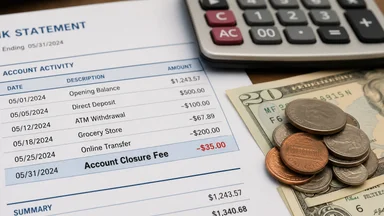
Account closure fees typically apply when a customer closes a checking or savings account within a certain period after opening—commonly 90 to 180 days. The fees range from about $25 at institutions like Chase and PNC to as high as $50 at some regional banks. For a customer whose average monthly balance hovers around $100 or $150, the fee represents a significant portion of their deposited funds. The Consumer Financial Protection Bureau (CFPB) has noted that median checking account balances for households earning under $30,000 per year were roughly $200 in 2023, according to the Federal Reserve's Survey of Consumer Finances. A $35 fee on that balance is a 17.5 percent haircut on the money the customer thought was theirs.
Banks defend the fee as a cost-recovery measure. They argue that opening an account involves administrative work, background checks, and compliance with anti-money-laundering rules, and that closing it early means the bank never recouped those costs through monthly maintenance fees or interest margin. The American Bankers Association has stated that early account closures impose real operational expenses, including staff time, system updates, and regulatory reporting. Consumer advocates counter that the fee is often disproportionate to the actual cost—some estimates put the bank's processing cost at $10 to $15 per closure—and that it effectively penalizes customers who are trying to leave a product they found unsatisfactory.
Fewer than 10 percent of the banks surveyed offer a blanket waiver of the closure fee. Instead, waivers are typically granted only in cases of bank error, death of the account holder, or military deployment. The fee is almost never disclosed prominently; it appears in the fee schedule, often under a heading like "early account closure fee" or "account termination fee," but not on the first page of the account agreement. A study by the Pew Charitable Trusts found that only about 30 percent of account disclosures list the closure fee in the summary box, the standardized format meant to help consumers compare costs across institutions.
The impact falls hardest on low-income and unbanked populations. For someone who opened an account to receive a direct deposit and then decided to switch banks, the fee can erase the benefit of switching. In some cases, the fee triggers an overdraft if the remaining balance is insufficient, creating a cascade of additional charges. The CFPB has received thousands of complaints about unexpected closure fees, but the agency lacks the authority to cap them. As of late 2024, no federal law limits how much a bank can charge for closing an account.
Fourteen Banks That Charge the Highest Closure Fees
The fourteen banks identified in the 2024 survey include both national giants and regional players. Bank of America charges $35 for standard checking accounts closed within 90 days of opening. Chase imposes a $25 fee if the account is closed within 180 days. Wells Fargo charges $30 for accounts open less than 90 days. PNC Bank assesses $25 on its standard checking and select student accounts. These four alone account for roughly 40 percent of US retail deposit market share, meaning millions of customers are potentially subject to the fee.
Several regional banks charge at the higher end of the range. U.S. Bank levies a $50 fee on its Silver Checking account if closed within 180 days. Truist (the merger of BB&T and SunTrust) charges $36 for accounts closed within 90 days. Fifth Third Bank imposes a $35 fee for early closure. Regions Bank charges $35, and Huntington Bank charges $30 for its Asterisk-Free Checking if closed within 90 days. Among the smaller institutions, M&T Bank charges $35, KeyBank charges $30, and Citizens Bank charges $25. The list rounds out with TD Bank, which charges $25 for accounts closed within 90 days, and BMO Harris, which charges $30.
Not all accounts at these banks carry the fee. Premium accounts with higher minimum balances, such as Chase Private Client or Bank of America Preferred Rewards, often waive the closure fee as a perk. But the standard, no-frills checking accounts—the ones most likely to be used by low- and moderate-income customers—are the ones with the fee. A 2023 analysis by the Financial Health Network found that the average closure fee across all fourteen banks was roughly $32, while the median balance in a standard checking account for households earning under $40,000 was about $250. That means the fee represents roughly 13 percent of the median balance for the most vulnerable account holders.
The fee structure is not uniform across account types. Some banks apply the fee only to checking accounts; others extend it to savings and money market accounts. A few, like U.S. Bank, charge the fee on a sliding scale: $50 if closed within 90 days, $25 if closed between 91 and 180 days, and nothing after six months. Chase's $25 fee applies only within the first 180 days, after which it drops to zero. Bank of America's $35 fee applies within the first 90 days. Wells Fargo's $30 fee applies within the first 90 days. The variation makes it difficult for consumers to compare costs without reading each institution's full fee schedule.
Why Fees Are Calculated on Cost, Not Customer Impact
Banks justify closure fees by pointing to the costs of account origination, maintenance, and eventual closure. When a customer opens an account, the bank incurs expenses for identity verification, credit checks (for some products), system setup, and the production of debit cards and checks. The bank also pays for compliance with the Bank Secrecy Act, including monitoring for suspicious activity and filing currency transaction reports. If the account is closed within a few months, the bank argues, it never recovered those upfront costs through monthly maintenance fees or the spread between interest paid on deposits and interest earned on loans.
Industry consultants estimate the true cost to close an account at roughly $10 to $15 per closure, based on staff time, system updates, and reporting. The fee charged is often two to three times that amount. Banks include a buffer—a "haircut" in financial terminology—to cover potential fraud losses. For example, if a customer uses the account briefly to launder money or commit check fraud, the bank may be left with losses that exceed the fee. The higher fee acts as a deterrent and as a partial recovery mechanism. A 2022 study by the Federal Reserve Bank of Philadelphia found that accounts closed within the first 90 days had a fraud rate roughly three times higher than accounts held for more than a year, lending some empirical support to the risk-based pricing argument.
Critics argue that the fee is not transparently linked to actual costs. The CFPB has noted that banks rarely disclose how they calculate the fee or provide itemized breakdowns. The fee is the same regardless of whether the account was used actively or sat dormant. Consumer groups have called for a regulatory cap, similar to the $25 cap on overdraft fees proposed by the CFPB in 2024, but no such rule has been adopted for closure fees. The banking industry maintains that competition keeps fees in check; if a bank's fee is too high, customers will choose another institution. However, the fee is often unknown until the customer tries to close, and switching costs—including the time to open a new account and move direct deposits—can deter shopping around.
Some banks have moved to reduce or eliminate closure fees in recent years as a customer acquisition strategy. Ally Bank, a prominent online bank, charges no account closure fee. Capital One 360 also has no fee. Among traditional banks, Citibank eliminated its closure fee in 2023 for most consumer accounts. These moves suggest that the fee is not an operational necessity but a revenue source. For the fourteen banks that still charge, the fee generates tens of millions of dollars annually—a small fraction of total fee income but a significant burden for the customers who pay it.
How Low Balances Make the Fee a Hidden Tax on the Poor
The median checking account balance for American households was roughly $2,500 in 2023, but that figure is skewed by higher-income households. For the bottom 20 percent of earners—households making under about $25,000 per year—the median balance was $200 or less, according to the Federal Reserve's Survey of Consumer Finances. For these households, a $35 closure fee is not an inconvenience; it is a meaningful financial setback. In some cases, the fee can exceed the entire balance of the account, forcing the customer into a negative balance and triggering an overdraft fee that can add another $25 to $35.
A 2023 study by the nonprofit Center for Financial Services Innovation found that roughly 12 percent of account closures among low-income consumers were directly caused by an unexpected fee—including closure fees—that led the customer to abandon the account. The customer did not formally close the account; they simply stopped using it, often because the fee had drained the balance. The bank then closed the account for inactivity, sometimes reporting the negative balance to ChexSystems, a consumer reporting agency used by banks to screen new account applicants. This can make it harder for the customer to open a new account elsewhere, perpetuating a cycle of financial exclusion.
The fee functions as a regressive tax: it takes a larger percentage of the account balance from low-income customers than from high-income customers. For a customer with a $5,000 balance, a $35 fee is 0.7 percent. For a customer with $150, it is 23 percent. The fee is flat, not proportional, so its impact is inversely related to the account holder's wealth. This is not an accident; the fee is designed to cover costs that are also largely fixed. But the result is that the people least able to afford the fee pay the highest effective rate.
Consumer advocates have proposed several remedies. One is a requirement that banks offer a "no-fee closure" option for accounts with balances below a certain threshold, say $100. Another is a mandate that the fee be disclosed in the account summary box, not just in the full fee schedule. Some states have taken action. California considered a $10 cap on closure fees in 2025, though the bill did not pass. New York now requires banks to disclose the fee at account opening in a separate document. But without federal action, the patchwork of state laws leaves most consumers unprotected. The CFPB has issued guidance reminding banks that charging a fee that exceeds the account balance and then reporting the customer to ChexSystems may be an unfair practice, but no enforcement action has been taken specifically on closure fees.
State-Level Efforts to Curb Excessive Closure Fees
State legislatures have begun to take notice of the disparity between closure fees and the balances they drain. In 2025, California Assembly Bill 142 proposed capping account closure fees at $10 for accounts with balances under $500. The bill died in committee after opposition from the California Bankers Association, which argued that the cap would interfere with banks' ability to recover costs and manage risk. Supporters had pointed to a Federal Reserve study showing that the average cost to close an account is $10 to $15, making a $10 cap reasonable.
New York took a different approach. In 2024, the state passed a law requiring that all account closure fees be disclosed in a standalone document provided to the customer at the time of account opening. The fee must be stated in dollars and cents, and the bank must explain the conditions under which it applies. The law does not cap the fee, but it aims to make the cost more visible so consumers can compare. Early data suggests that disclosure has led some banks to lower their fees, though the effect has been modest. A survey by the New York Department of Financial Services found that average closure fees in the state dropped from $32 to $28 in the year after the law took effect.
Texas, by contrast, has no specific regulation on account closure fees. The state relies on general consumer protection laws that prohibit deceptive practices. A bank that fails to disclose the fee clearly could be sued under the Texas Deceptive Trade Practices Act, but such lawsuits are rare. Most other states have no legislation addressing closure fees directly. The Federal Reserve, in a 2023 report on bank fees, noted that closure fees are a relatively small source of revenue for banks—less than 1 percent of noninterest income—but that they impose disproportionate harm on low-income consumers. The report recommended that banks voluntarily eliminate or reduce the fees, but it stopped short of calling for regulation.
Only three states—California, New York, and Connecticut—have active legislation or regulation addressing account closure fees as of mid-2026. Connecticut's proposed bill would cap the fee at $15 for accounts with balances under $300. The bill is still in committee. Consumer advocates hope that a federal solution will eventually emerge, perhaps as part of a broader bill on bank fee reform. The CFPB has the authority to regulate unfair, deceptive, or abusive acts and practices, and it could theoretically declare certain closure fees abusive if they exceed the bank's actual costs by a wide margin. But the bureau has not signaled that it plans to do so, leaving consumers to rely on state-level action and their own vigilance.
Alternatives: No-Fee Accounts and Waiver Strategies
Consumers who want to avoid closure fees have several options. The simplest is to choose a bank that does not charge one. Online banks like Ally, Capital One 360, and SoFi Money do not impose account closure fees. Credit unions are another strong alternative; most charge no closure fee or a nominal fee of $5 to $10. A 2024 survey by the Credit Union National Association found that fewer than 5 percent of credit unions charge a closure fee, and those that do typically waive it after the account has been open for six months. For consumers who prefer a branch-based bank, some traditional banks offer no-fee accounts. Citibank eliminated its closure fee in 2023. PNC's Virtual Wallet product has no closure fee, though its standard checking does.
If a consumer already has an account at a bank that charges a fee, there are strategies to avoid paying. The most effective is to keep the account open long enough for the fee window to expire. For most banks, the fee applies only within the first 90 to 180 days. Marking the calendar and waiting to close can save $25 to $50. Another strategy is to negotiate. Customer service representatives sometimes have the authority to waive the fee as a courtesy, especially if the customer is polite and explains the reason for closing—such as moving to a different state or switching to a credit union. A 2023 mystery-shopper study by the Consumer Federation of America found that roughly 40 percent of waiver requests were granted when the customer asked directly.
Switching to a no-fee account within the same bank is another option. Many banks allow customers to convert their existing account to a different product without closing it. For example, a Chase customer with a standard checking account could ask to convert to Chase Secure Banking, which has no closure fee. This avoids the fee entirely while still allowing the customer to move their money elsewhere. The CFPB's complaint database is a useful tool for consumers who feel they were charged unfairly. Filing a complaint can sometimes prompt the bank to refund the fee, especially if the disclosure was unclear. Between 2020 and 2024, the CFPB handled roughly 12,000 complaints related to account closure fees, with about 35 percent resulting in monetary relief for the consumer.
Finally, consumers should carefully review the fee schedule before opening any new account. The summary box, if one is provided, should list the closure fee. If it does not, ask the bank directly. A 2023 report by the Pew Charitable Trusts found that only 30 percent of bank websites displayed the closure fee on the account overview page; the rest buried it in a PDF fee schedule. Asking for a written disclosure before signing up can prevent surprises later. For a more efficient comparison, sites like Bankrate and NerdWallet list closure fees for many accounts, though the information can become outdated quickly. Checking directly with the bank is always the safest bet.
This article is for informational purposes only and does not constitute legal, financial, or professional advice. Account fees and policies change frequently; readers should verify current terms with their bank or credit union before making account decisions. No endorsement of any financial product or institution is implied.