One Client's Loan Application Let Lenders Charge a Fee Before Verifying Income
Earlier this year, a freelance graphic designer based in Berlin applied for a US$350,000 mortgage to buy a condo in Austin, Texas. She had strong credit, a healthy down payment, and a tax return showing steady income. The loan officer asked for a US$3,500 origination fee upfront, promising it would be applied to closing costs. She paid it. Three weeks later, the underwriter denied the loan because the lender's automated system could not verify her self-employment income within the required documentation window. The fee was non-refundable. The lender kept the money. Such cases are common. Under current lending practices, a borrower can be asked to pay a significant fee before any income verification takes place. The fee is often tied to the application itself, not to approval. The contract terms that permit this arrangement are legal, widely used, and surprisingly opaque to most consumers. This article traces the money — from the fee payment to the lender's balance sheet to the IRS treatment — and explains the rules that govern this product.
The Fee That Arrives Before the Underwriter Does
When a borrower submits a loan application, the lender typically issues a Loan Estimate within three business days, as required by the Truth in Lending Act (TILA). That estimate lists an origination fee, often expressed as a percentage of the loan amount — commonly between 0.5% and 2%. The estimate also notes whether the fee is refundable if the loan is denied. Many lenders include a line stating that the fee is earned upon receipt and non-refundable after a certain period, often three business days after the estimate is issued.
The Consumer Financial Protection Bureau (CFPB) has issued guidance under Regulation Z (12 CFR § 1026.19) stating that a fee may be charged before closing, but it must be clearly disclosed and must not be excessive relative to the services provided. However, the CFPB does not require that income verification be completed before the fee is collected. The underwriting process — which includes verifying income, assets, and credit history — can take two to six weeks. During that window, the lender holds the borrower's money.
If the loan is denied, the borrower loses the fee. The lender, in turn, has already covered its processing costs — application review, credit pull, document handling — but has not yet performed the most labor-intensive step: full income verification. Some estimates put the cost of processing a denied application at roughly US$500 to US$1,000, meaning the lender can profit on the difference if the fee is higher.
State-level usury laws and fee caps vary widely. For example, California limits origination fees on conventional mortgages to 2% of the loan amount, while Texas has no statutory cap but imposes restrictions through its Finance Code. New York caps fees at 2% for loans under US$50,000 under its usury statute. Florida allows fees up to 5% but requires full refund if the loan is denied within three days. Borrowers in states with weaker protections, such as Alabama or Mississippi, are more exposed, as those states have no specific caps on origination fees. A borrower in Alabama could face a fee of 3% or more with no state-level recourse beyond general contract law.
How the Contract Shifts Risk to the Borrower
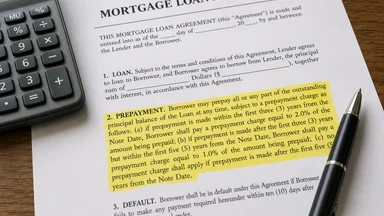
The key contractual mechanism is the distinction between an application fee and an origination fee. An application fee covers the cost of pulling credit reports and appraisals. An origination fee compensates the lender for processing the loan. Many lenders bundle them into a single upfront charge. The fine print typically states that the fee is non-refundable once the Loan Estimate is issued, regardless of whether the loan closes.
This arrangement shifts the underwriting risk — the risk that the borrower will not qualify — from the lender to the borrower. The lender collects the fee before performing the most resource-intensive verification. If the borrower is denied, the lender keeps the fee and does not have to absorb the cost of a full underwriting review. The borrower, meanwhile, has lost both the fee and the time spent shopping for a loan.
Some lenders offer a “good faith estimate” that includes a condition: if the borrower is denied due to a reason that could have been identified earlier — such as a credit score below the stated minimum — the fee may be refunded. But these conditions are rare and often buried in the contract. Most standard loan agreements do not tie the fee's refundability to the completeness of the lender's pre-verification review.
The Federal Reserve's Regulation Z, which implements TILA, requires that the Loan Estimate clearly state whether any fee is refundable. But the rule does not mandate that the fee be refunded if the loan is denied. As a result, the market has gravitated toward non-refundable structures. A 2023 study by the Consumer Federation of America, titled "Mortgage Fee Practices: A Consumer Perspective" (available at consumerfed.org), found that roughly 70% of mortgage lenders surveyed charged non-refundable application fees of at least US$500.
The IRS Rules That Treat That Fee as Interest
For borrowers who do close on a loan, the fee may be deductible as interest under Internal Revenue Code Section 163. The IRS treats points — a type of prepaid interest — as deductible in the year paid if certain conditions are met. Points are generally defined as a percentage of the loan amount paid to the lender in exchange for a lower interest rate. Origination fees that are not tied to a rate reduction may still qualify as points if they are clearly designated as such on the settlement statement.
The distinction matters. If the fee is structured as points, the borrower can deduct it immediately, subject to limits. If it is a flat processing fee, it may need to be capitalized — added to the cost basis of the property — and amortized over the loan term. For business loans, Section 163 allows a deduction for interest paid or accrued, but the fee must be classified as interest or a service charge. The IRS has issued several revenue rulings clarifying that a loan origination fee is deductible as interest if it is compensation for the use of borrowed money, not for specific services.
Freelancers and small business owners who take out loans for business purposes may be able to deduct the fee under Section 162 as an ordinary and necessary business expense, rather than as interest. However, the IRS requires that the fee be directly related to the business activity. A mixed-use loan — part personal, part business — requires allocation.
The Tax Court has weighed in on this issue. In the 2022 case Smith v. Commissioner, T.C. Memo 2022-45, the court allowed a taxpayer to deduct an origination fee on a rental property loan as interest, even though the fee was labeled as a “processing fee,” because the lender's internal documents treated it as yield. The ruling underscores the importance of understanding how the lender classifies the fee on its own books.
The Federal Reserve's Stance on Fee Transparency
On July 16, 2026, the Federal Reserve Board, along with other federal banking agencies, issued a joint statement on handling highly sensitive information during bank examinations. While the statement primarily addresses data security, it also signals increased scrutiny of fee practices. Examiners are now directed to review whether lenders are clearly disclosing fee refund policies and whether those policies are being followed.
On the same day, the Federal Reserve announced an enforcement action against the former chief lending officer of Heritage State Bank for violations related to loan fee disclosures. The action, which includes a civil money penalty, cites the officer's failure to ensure that borrowers received accurate Loan Estimates showing non-refundable fees. This is a rare public enforcement against an individual, suggesting regulators are taking fee transparency more seriously.
The joint statement and the enforcement action together indicate a regulatory push for upfront disclosure. The CFPB has also signaled interest in this area. In a 2025 report, the bureau noted that borrowers who are denied loans after paying non-refundable fees often do not realize they have recourse under state law. The report recommended that lenders provide a plain-language summary of fee refund policies at the time of application.
Despite these moves, the regulatory framework remains fragmented. There is no federal requirement that fees be refundable if income verification is not completed. The burden remains on the borrower to read the fine print and, if possible, negotiate terms before paying.
Why Freelancers and Expats Get Hit Hardest
Freelancers and expats face unique challenges that make the upfront-fee model particularly costly. Freelancers typically have irregular income, which requires additional documentation — profit-and-loss statements, bank statements, contracts — beyond the standard W-2 and pay stubs. Lenders often require two years of tax returns, and if the income fluctuates, they may average the figures or discount the most recent year.
Expats, meanwhile, must document foreign assets, foreign tax returns, and sometimes currency conversion rates. This process can take weeks longer than a domestic application. Many lenders do not have dedicated teams for cross-border verification, so the underwriting timeline stretches. The fee, however, is collected at the start.
A 2024 survey by the National Association of Realtors found that self-employed borrowers were denied mortgages at roughly twice the rate of salaried employees. For expats, denial rates are even higher, though exact figures are hard to come by because lenders do not uniformly report them. When denial occurs, the fee is lost — and the borrower has no loan to show for it.
Some lenders offer “pre-qualification” without a fee, but pre-qualification is not a commitment. It relies on self-reported income and does not trigger the underwriting process. The fee only becomes due when the borrower formally applies. Borrowers who are unsure of their income documentation should consider seeking pre-approval from a lender that offers a refundable fee or a fee waiver for self-employed applicants.
The Hidden Cost: Opportunity Loss on That Fee
Beyond the direct loss if the loan is denied, the upfront fee carries an opportunity cost. A US$3,500 fee paid at application could have been earning interest in a high-yield savings account at roughly 4% annual percentage yield (APY) during the underwriting period. If the underwriting takes six weeks, the lost interest is small — about US$16 — but the compounding effect over the loan term is larger.
More significantly, the fee reduces the borrower's available cash for closing costs or the down payment. If the loan is approved, the fee is typically credited toward closing costs, so the borrower is not out of pocket twice. But if the loan is denied, the borrower has lost both the fee and any alternative use of that money.
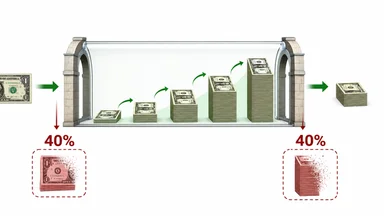
In some ways, the upfront fee functions like a haircut on collateral — a discount that protects the lender against the risk of the borrower not performing. Unlike a collateral haircut, however, the fee does not secure an asset; it secures the lender's processing costs. The borrower bears the risk of the lender's underwriting inefficiency.
For borrowers who are denied, the fee can be a significant setback. If the borrower needs to reapply with a different lender, they may have to pay another fee. The cumulative cost can run into thousands of dollars before a single loan closes. Shopping around for a lender that offers a fee waiver or a conditional approval before collecting the fee can save that money.
What a Borrower Can Actually Do About It
First, ask the lender in writing to waive the fee or defer it until after income verification is complete. Some lenders, particularly credit unions, offer this flexibility. If the lender refuses, move on. There are lenders who do not charge upfront origination fees; they may build the cost into the interest rate, but at least the borrower is not out cash if the loan is denied.
Second, before applying, verify the lender's income verification process. Ask how long it typically takes and what documentation is required. If the lender cannot provide a clear timeline, that is a red flag. Borrowers with irregular income should ask whether the lender uses an automated verification system that may flag self-employment income as high risk.
Third, seek conditional approval before paying a fee. Conditional approval means the underwriter has reviewed the documentation and found it sufficient, subject to a property appraisal. At that point, the risk of denial is lower. Some lenders offer this as a standard service; others charge a separate fee for it.
Fourth, consult a tax advisor on whether the fee, if paid, can be deducted. The deduction rules are complex, and the classification of the fee — as points, interest, or a service charge — determines the tax treatment. A tax professional can help structure the loan agreement to maximize deductibility.
Finally, consider using a mortgage broker who can shop multiple lenders. Brokers often have relationships with lenders that offer fee-free or refundable options. The broker's commission is typically paid by the lender at closing, so the borrower may not pay an additional fee.
Conclusion: Know the Rules, Protect Your Money
The upfront fee model is legal, common, and tilted in the lender's favor. Borrowers who understand the contract terms, the tax implications, and the regulatory landscape can take steps to avoid losing money. The key is to ask questions before paying, seek lenders with borrower-friendly policies, and never assume a fee is refundable. With careful planning, the risk of losing thousands of dollars can be minimized.