One Disability Insurance Definition Delays Payout by Sixteen Months After the Injury
A construction foreman in his late forties fell from a scaffolding, fracturing two vertebrae. He had carried a disability policy for over a decade, paying premiums reliably. He expected the policy to replace a portion of his income while he recovered. Instead, he waited sixteen months for a single payout—and only after litigation. The reason was not a hidden exclusion or a missed deadline. It was a single word in the definition of disability: “any.”
The Sixteen-Month Gap Between Injury and Payout
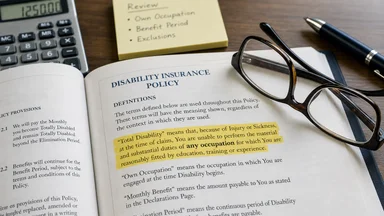
The foreman’s policy defined total disability as the inability to perform the material duties of any occupation for which he was reasonably suited by education, training, or experience. After the fall, he could no longer lift heavy materials, operate heavy machinery, or stand for extended periods—the core tasks of a construction foreman. But he could sit at a desk, answer phones, and manage paperwork.
The insurer argued that because he retained the functional capacity to perform sedentary or clerical work, he did not meet the definition of total disability. They pointed to vocational rehabilitation reports listing potential jobs: dispatcher, inventory clerk, safety monitor. None paid near his former salary, but the policy only required the ability to perform some gainful occupation, not one with comparable earnings.
The foreman’s attorney countered that his education and experience were in construction, not office administration. The court, however, applied the policy’s plain language. The case stretched through discovery, depositions, and a mediation that collapsed when the carrier refused to budge. Sixteen months after the injury, the parties settled for roughly 60% of the total benefit amount the foreman would have received if the claim had been paid promptly.
This case is not unusual. Disability insurers rely on precisely such definitional gaps to contest claims, especially when the policy uses an “any occupation” standard. Understanding the difference between that standard and an “own occupation” definition is the single most important step anyone can take before buying a policy.
The 'Own Occupation' vs 'Any Occupation' Trap
Disability insurance policies fall into two broad categories based on how they define total disability. An own-occupation policy considers you totally disabled if you cannot perform the material duties of your specific occupation, even if you could work in another field. An any-occupation policy, by contrast, requires that you be unable to perform any job for which you are reasonably qualified.
The cost difference is substantial. Own-occupation premiums typically run about 25% higher than any-occupation policies for the same benefit amount, according to industry rate filings from 2024. That premium gap narrows for younger buyers in low-risk professions, but it widens for older applicants or those in physically demanding roles like construction, nursing, or law enforcement.
Most employer-provided group disability plans use any-occupation wording. The employer subsidizes the premium, so the trade-off is lower cost for narrower coverage. Individual policies, by contrast, often offer an own-occupation rider at an additional cost. The rider may be labeled “true own-occupation” or “transitional own-occupation,” with subtle differences in how long the own-occupation definition applies before switching to an any-occupation standard—often two years.
The choice is not merely academic. A 2023 study by the Disability Insurance Resource Center found that own-occupation policies paid claims at a rate roughly 30% higher than any-occupation policies for similar injury types, when adjusted for occupation class. The gap was largest for musculoskeletal injuries, the most common disability claim category. For the construction foreman, an own-occupation policy would have recognized his inability to work as a foreman as total disability, regardless of whether he could theoretically answer phones.
Beyond the own-occupation versus any-occupation distinction, disability policies layer additional definitions that affect when and how benefits are paid. One of the most consequential is the elimination period—a waiting period between the onset of disability and the start of benefit payments. Elimination periods typically range from 30 to 180 days. A longer elimination period lowers the premium, but it also means the policyholder must cover living expenses out of pocket for that duration.
The benefit period caps how long benefits are paid. Common options are two years, five years, or to age 65. Some policies offer lifetime benefits for certain injuries, but those are rare and expensive. The shorter the benefit period, the lower the premium—but also the higher the risk that a long-term disability exhausts coverage before the policyholder can return to work.
Residual disability clauses are another critical feature. A residual disability clause pays a partial benefit if you can work but only part-time or at reduced earnings due to the disability. Without such a clause, earning even a small amount of income might disqualify you from total disability benefits entirely. Some policies require a minimum earnings loss—often 20%—before residual benefits kick in.
Pre-existing condition exclusions vary by state and contract. Most policies exclude conditions for which you received medical advice or treatment in the 12 to 24 months before the policy effective date. Group plans often waive this exclusion for employees who enroll when first eligible. Individual policies may impose a look-back period, and some states limit how far insurers can look back. The variation means two people with identical medical histories could face different coverage outcomes depending on where they live.
Finally, many policies include a mental/nervous disorder limit, capping benefits for mental health conditions at 24 months. This limit does not apply to physical conditions, but it can be a trap for disabilities with both physical and psychological components, such as chronic pain or concussion syndromes. The fine print often requires the insurer to determine the primary cause, which can become a point of contention.
The Financial Mechanics Behind the Delay
When an insurer denies a claim or delays payment, the decision is not arbitrary. It is driven by financial incentives embedded in the insurance business model. Insurers set aside reserves for expected claim payouts, calculated using actuarial assumptions about claim duration and severity. If a claim is contested, the reserve may be set lower than the full potential payout, freeing capital for other uses.
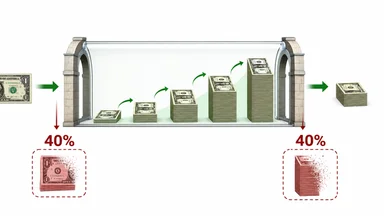
Insurers also apply a haircut to collateral in reinsurance agreements. Reinsurers share the risk of large claims, but they often require the primary insurer to retain a portion—the haircut. If the primary insurer can avoid paying a claim, it avoids triggering the reinsurance layer and preserves its own loss ratio. This creates a subtle incentive to deny borderline claims, especially those with high potential costs.
Litigation costs are factored into loss-adjustment expense ratios, which measure the cost of investigating and defending claims relative to premiums. A carrier that consistently pays claims quickly will have lower legal expenses but higher claim payouts. A carrier that contests a significant fraction of claims may have higher legal costs but lower overall claim payouts if many denials are upheld. The optimal balance for the insurer depends on its risk appetite and regulatory environment.
Meanwhile, the insurer earns float on premiums collected but not yet paid out. During a sixteen-month delay, the carrier invests the disputed funds and keeps the investment income, even if it eventually pays the claim. This float is a significant profit center for large insurers. According to a 2024 report by the National Association of Insurance Commissioners titled Disability Insurance Market Overview, the top ten disability carriers collectively held roughly $12 billion in claim reserves, earning an estimated $400 million in investment income annually during contest periods.
Regulatory capital requirements also play a role. Insurers must hold capital proportional to the risk of their claim portfolios. Denying a claim reduces the reported liability, which lowers the required capital. This can improve the insurer's return on equity, a key metric for investors. The cumulative effect is a system where the financial architecture subtly encourages delay and denial, even when the claim is ultimately valid.
Real-World Data on Claim Denial Rates
How common are claim denials? The Council for Disability Awareness, a non-profit industry group, reported in its 2024 claims study that roughly 35% of individual disability claims are denied at the initial review. The denial rate for group policies is slightly lower, around 30%, because group underwriting is less stringent at the point of claim. However, group policies are more likely to use any-occupation definitions, so the denial rate for total disability claims under group plans may be understated.
Of the initial denials, about 10% are overturned on appeal. The appeals process is governed by the policy terms and, for employer-provided plans, by the Employee Retirement Income Security Act (ERISA). ERISA imposes strict deadlines: claimants typically have 180 days to appeal, and insurers must decide within 45 days. But ERISA also limits the remedies available; claimants cannot sue for extra-contractual damages like emotional distress, and the court reviews the insurer's decision under a deferential standard if the policy grants the insurer discretionary authority.
State insurance departments track complaint ratios for each carrier. The National Association of Insurance Commissioners publishes an annual complaint index, comparing the number of complaints relative to market share. Carriers with high complaint ratios for disability claims often have more restrictive policy language or aggressive claims practices. A 2024 report by the Consumer Federation of America identified five carriers whose disability complaint ratios were more than double the industry average.
Denial rates also vary by occupation class. Professional and managerial occupations—where job duties are primarily mental—see lower denial rates for any-occupation policies because the policyholder can still perform their own job after many injuries. Manual and physical occupations see higher denial rates under any-occupation policies because the insurer can point to sedentary alternatives. A 2023 analysis by the Society of Actuaries found that construction workers faced denial rates nearly twice those of accountants under identical any-occupation policies.
To illustrate the practical impact, consider a nurse who injures her back and can no longer lift patients. Under an any-occupation policy, the insurer might argue she could work as a telephone triage nurse or a health educator—jobs that do not require lifting. While those roles exist, they may pay less and require retraining. The nurse might face a similar sixteen-month battle, even though her disability is genuine. Another example: a police officer with a knee injury that prevents running and physical restraint. An any-occupation policy could point to security desk jobs or dispatch roles, ignoring the fact that those jobs are not equivalent in pay or satisfaction. These real-world scenarios underscore the importance of the own-occupation versus any-occupation distinction.
Three Contract Clauses That Change Everything
Beyond the core definitions, three specific contract clauses can determine whether a claim is paid or denied. The first is the definition of “regular occupation.” In own-occupation policies, the term “regular occupation” may refer to the specific job you held at the time of disability, or it may reference the standard duties of that occupation as defined by the Department of Labor. If the policy uses the latter, the insurer can argue that a construction foreman’s regular occupation includes some sedentary supervisory tasks, reducing the threshold for what counts as disability.
The second clause is the proof-of-loss deadline. Most policies require that you submit proof of loss—medical records, earnings statements, and a claim form—within 90 days of the onset of disability. Some policies allow up to a year, but the clock starts ticking immediately. Missing this deadline can void the claim, even if the disability is legitimate. The deadline is often buried in the policy's “general provisions” section, not the main coverage part.
The third clause is the offset provision. Many disability policies reduce benefits dollar-for-dollar by any Social Security Disability Insurance (SSDI) or workers' compensation payments you receive. The offset is often retroactive: if SSDI is approved months later, the insurer can demand repayment of overpaid benefits. Some policies also offset by retirement plan distributions or other disability coverage. Without careful planning, the offset can leave the policyholder with far less than the advertised benefit amount.
Two additional clauses merit attention. The change-of-occupation notification requirement often requires the policyholder to inform the insurer if they switch to a more hazardous occupation. Failure to notify can void coverage for claims arising after the change. The waiver-of-premium feature stops premium payments during total disability, but it may not apply during residual disability or elimination periods, creating a cash-flow gap just when the policyholder is most vulnerable.
To avoid redundancy, note that the any-occupation definition is the core trap that underpins many of these clauses. The proof-of-loss deadline and offset provision can exacerbate the impact of an any-occupation definition, but the primary risk remains the definition itself. Policyholders should focus on the definition first, then the ancillary clauses.
Practical Steps Before You Sign the Application
Before purchasing a disability policy, ask for sample policy language in writing. Many insurers provide a summary of benefits, but the actual contract is what governs claims. Review the definitions of total disability, residual disability, and regular occupation. Compare the own-occupation and any-occupation versions side by side. If the agent cannot or will not provide sample language, consider that a red flag.
Check the insurer's financial strength rating from A.M. Best, Moody's, or Standard & Poor's. A rating of A- or higher indicates the carrier is likely to remain solvent over the long term. Disability claims can last decades, so the insurer's stability matters. Also review the company's complaint ratio on the NAIC website; a ratio above 1.0 means more complaints than average for its market share.
Ask about residual and partial disability coverage. Some policies only pay total disability benefits, leaving a gap if you can work part-time. A policy with a residual disability clause will pay a proportionate benefit based on lost earnings. This feature is especially important for professionals whose income depends on billable hours or productivity.
Review the elimination period options against your emergency savings. If you have three months of expenses saved, a 90-day elimination period may be appropriate. If your savings are thinner, a shorter elimination period—30 or 60 days—may be worth the higher premium. Also consider the benefit period: a policy that pays to age 65 provides more security than a five-year benefit, but the premium difference can be substantial.
Finally, work with an independent agent who represents multiple carriers. A captive agent who sells only one company's products cannot compare policies objectively. Ask the agent to explain the claim process: what documentation is needed, how long approvals typically take, and what the carrier's track record is for paying claims in your occupation class. A good agent will walk you through the fine print and help you choose a policy that matches your risk profile, not just the cheapest premium.
The construction foreman eventually received a settlement, but it covered only legal fees and a fraction of his lost income. He had assumed his policy would protect him. The assumption cost him sixteen months and tens of thousands of dollars. The lesson is not to avoid disability insurance—it is to read the definition of disability before you need it.
Looking ahead, regulatory changes may shift the landscape. Some states are considering legislation that would require a minimum standard of own-occupation coverage for certain professions, similar to existing laws in a handful of states. However, such reforms are not guaranteed, and the burden remains on the individual to understand their contract. The best approach is to treat the policy as a legal document, not a marketing brochure, and to seek professional advice if any clause is unclear.
This article is for informational purposes only and does not constitute personalized financial or legal advice. The suggestions provided—such as working with an independent agent or checking financial strength ratings—are general in nature and may not be suitable for your specific situation. Consult a licensed insurance professional or attorney for advice tailored to your circumstances.