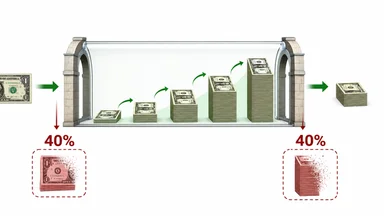
Your Trust’s Fee Schedule Deducts a Quarterly Charge on Funds You Cannot Access
When you fund a trust, you expect your assets to be managed prudently. What many do not realize is that the trust's fee schedule deducts a quarterly charge on funds you cannot access. These deductions, buried in initial disclosure documents, can quietly erode the principal over years. This article breaks down what those fees are, who collects them, and why they matter.
The Quarterly Deduction Nobody Reads
Trust administration fees are often hidden in fine print. The fee schedule, typically provided at the time of funding, lists a quarterly charge calculated as a percentage of the trust's assets. Beneficiaries rarely see this deduction until the annual statement arrives, and by then the money is gone.
These quarterly charges apply to the principal you cannot withdraw. Unlike a bank account where you can move funds to avoid fees, trust assets are locked. The trustee controls distributions, and you cannot simply transfer the money to a lower-cost provider. The fee is deducted from the gross value of the trust, not from income generated, so even if the trust earns nothing, the fee still applies.
Typical annual fees range from 0.5% to 1.5% of assets, but some trusts charge higher. A 1% annual fee on a $500,000 trust means $5,000 per year in deductions, or roughly $1,250 per quarter. Over 20 years, that same fee consumes over $100,000 in potential growth, assuming modest returns. If the trust grows at an average of 5% per year, the fee reduces the ending balance by approximately 20% compared to a no-fee scenario—a substantial erosion that many beneficiaries fail to anticipate.
The fee schedule is buried in the initial disclosure documents, often alongside pages of legal boilerplate. Many beneficiaries never read it, and those who do may not understand the implications until years later.
Who Collects and What They Earn
Trustees, custodians, and investment managers each take a slice of the trust's assets. The trustee, often a bank or trust company, charges an administrative fee for overseeing the trust. Custodians hold the assets and charge custody fees, typically 0.1% to 0.3% of assets per quarter. Investment managers add another layer, usually 0.5% to 1% annually.
Administrative fees cover tax filings, account statements, and legal compliance. These can be fixed or percentage-based. Some trustees charge a flat annual fee of $2,000 to $5,000, while others take a percentage. The total drag from all layers can reach 2% to 3% per year on inaccessible funds.
For example, a $1 million trust with a 1% trustee fee, 0.2% custody fee, and 0.8% investment management fee pays $20,000 annually. That is $5,000 per quarter, deducted before any distributions are made. The beneficiary receives only what remains after these deductions. Over a decade, the total fees could exceed $200,000, even before accounting for compounding.
Some trustees also charge transaction fees for buying or selling assets, adding another cost. These fees are rarely disclosed upfront and can vary widely. A single trade might cost $50 to $150, and active management can generate dozens of trades per year. For a trust with a portfolio turnover of 50% annually, transaction costs alone could add another 0.2% to 0.5% to the total expense ratio.
Consider a real-world scenario: a family trust worth $2 million with a 1.2% annual trustee fee, 0.3% custody fee, and 0.9% investment management fee. That adds up to 2.4% per year, or $48,000 annually. If the trust earns a 6% return before fees, the net return drops to 3.6%, meaning the trust only keeps a little more than half of its investment gains. Over 20 years, the difference in ending value between a 2.4% fee and a 1.2% fee could be several hundred thousand dollars—a gap that widens dramatically with time.
The Liquidity Penalty You Pay for Locked Assets
Assets held in trust cannot be sold or moved without trustee approval. This lack of liquidity imposes a penalty: quarterly fees are calculated on the gross value of the trust, not on the amount you can actually spend. If the trust holds illiquid assets like real estate or private equity, the valuation may be higher than the cash available, yet fees are still charged on that inflated figure.
Market value haircuts apply for illiquid holdings. In finance, a haircut is the difference between market value and the value ascribed for collateral purposes. For trust assets, this means the trustee may apply a discount when calculating net worth, but fees are still based on the gross value before the haircut.
Illiquid assets like real estate or private equity incur higher fees because they require more administrative work. Appraisals, legal reviews, and specialized management all add cost. These fees are passed to the beneficiary, who cannot access the funds to shop for better rates.
Once the trust is funded, there is no ability to negotiate lower fees. The fee schedule is set at inception, and changing trustees often requires court approval, which is costly and time-consuming. Beneficiaries are effectively locked into the fee structure.
To illustrate, imagine a trust that holds a commercial real estate property valued at $1 million. The property generates little cash flow, but the trust pays quarterly fees on the full $1 million valuation. If the fee is 1% annually, that's $10,000 per year—money that might have to come from selling other assets or from the grantor's pocket. Meanwhile, the beneficiary cannot access the property's value without trustee consent and a lengthy sale process. This liquidity penalty is a hidden cost that many grantors overlook when choosing trust assets.
How Fees Compare Across Trust Structures
Revocable living trusts, which can be changed by the grantor, typically have lower fees, often 0.5% to 1% annually. These trusts are simpler to administer and require less ongoing legal work. However, they still deduct quarterly charges on assets you cannot access during the grantor's lifetime if you are a beneficiary.
Irrevocable trusts, which cannot be changed once funded, carry higher fees, often 1% to 2% annually. The complexity of tax reporting and legal compliance drives up costs. These trusts are common for estate tax planning and asset protection, but the fee drag is significant. For example, a $3 million irrevocable life insurance trust might pay 1.5% annually in trustee and investment fees, totaling $45,000 per year—a substantial sum that reduces the death benefit available to beneficiaries.
Charitable remainder trusts deduct fees before distributions are made to the charity. The trustee's fee comes off the top, reducing the amount available for the charitable beneficiary. Some estimates put the total fee burden at 1.5% to 2.5% annually for these structures. A $500,000 charitable remainder trust with a 2% annual fee costs $10,000 per year, meaning less money for the charity and potentially lower income for the donor.
Bank-administered trusts tend to charge more than independent trustees. Large banks have overhead costs and often bundle services, leading to higher fees. Independent trustees may offer lower rates but may lack the resources for complex investments. Fee differences of 0.5% can compound to tens of thousands of dollars over decades. For a $1 million trust held for 30 years, a 0.5% difference in annual fees amounts to roughly $150,000 in lost growth, assuming a 6% return.
Another structure to consider is the special needs trust, designed for beneficiaries with disabilities. These trusts often have higher administrative costs due to government reporting requirements and benefit coordination. Fees can range from 1% to 2.5% annually, and the beneficiary may have limited ability to challenge them. Given that the trust is meant to last a lifetime, the cumulative fee impact can be enormous.
On the other hand, some grantors argue that higher fees are justified by the expertise and liability protection that professional trustees provide. A trustee who avoids a costly lawsuit or successfully navigates complex tax rules may save the trust far more than the fees they charge. The trade-off is between cost and peace of mind, but the lack of transparency makes it hard to evaluate whether the fees are reasonable.
The Regulatory Gaps That Allow Fee Creep
There is no federal cap on trust administration fees in the United States. State laws vary widely on fee disclosure requirements. Some states require itemized statements, while others allow trustees to charge a blanket percentage without detail. The Uniform Trust Code, adopted in many states, only requires fees to be 'reasonable,' but does not define what that means.
Trustees can charge for services the beneficiary cannot opt out of. For example, tax preparation fees are mandatory because the trust must file returns. But the trustee may charge a premium for this service, and the beneficiary has no alternative provider. This creates a captive market.
Litigation over fees is rare due to the cost and lack of beneficiary standing. Beneficiaries often lack the legal standing to challenge fees unless they can prove breach of fiduciary duty. Legal fees can easily exceed the disputed amount, making lawsuits impractical for all but the largest trusts.
Some states have begun to address these gaps. California, for instance, requires trustees to provide annual fee disclosures. But enforcement is weak, and many beneficiaries remain unaware of their rights. The regulatory landscape remains fragmented and tilted toward the trustee.
For example, in New York, trustees must provide a detailed accounting upon request, but beneficiaries must know to ask. In Florida, the law allows trustees to charge a 'reasonable' fee, but what is reasonable is often determined by industry standards rather than a clear statutory formula. This ambiguity leaves room for fee creep over time, especially if the trust's assets grow or become more complex.
Some critics argue that the lack of regulation is intentional, as trust fees are a lucrative revenue stream for banks and financial institutions. The industry lobby has successfully opposed efforts to mandate standardized fee disclosures, arguing that trusts are too diverse for a one-size-fits-all approach. Meanwhile, beneficiaries bear the cost.
A counter-argument is that competitive pressure among trustees should keep fees in check. In theory, if a trustee charges too much, the grantor can choose another. But in practice, once a trust is funded, switching is difficult and costly. The initial selection is critical, but many grantors rely on recommendations from attorneys or financial advisors who may have conflicts of interest.
Three Ways to Control Costs Before Signing
First, negotiate fee caps or a fixed annual fee instead of a percentage. A flat fee of $3,000 per year may be cheaper than a 1% fee on a $500,000 trust. Caps prevent fees from rising as the trust grows. Some trustees will agree to a cap if asked upfront. For larger trusts, a tiered fee structure—where the percentage decreases as assets grow—can also be beneficial.
Second, require itemized quarterly statements showing each deduction. Insist on a breakdown of trustee fees, custody fees, investment management fees, and administrative costs. This transparency allows you to spot duplicate charges or unnecessary services. For example, if the trustee charges both an administrative fee and a separate fee for tax preparation, you can ask whether the administrative fee already covers that service.
Third, review the fee schedule with an independent fiduciary, not the trustee's lawyer. An independent advisor can compare the proposed fees to market rates and identify red flags. They can also help negotiate terms before the trust is funded. This step is especially important for irrevocable trusts, where changes are nearly impossible later.
Avoid bundled fees that mix investment and administrative charges. Bundled fees make it hard to see what you are paying for each service. Ask for separate line items. Consider directed trusts where you retain investment control, which can reduce management fees. In a directed trust, the trustee handles administrative tasks while you or an investment advisor manage the assets, potentially cutting investment management fees in half.
Another strategy is to consider a trust that allows for removal and replacement of the trustee without court approval. Some trusts include a provision that allows beneficiaries to change trustees if fees become unreasonable. This gives leverage to negotiate lower fees later. However, not all trustees will agree to such terms, and they may charge a premium for the flexibility.
By taking these steps before signing, you can reduce the quarterly drag on your trust assets. But even with careful planning, some fees are unavoidable. The key is to understand what you are paying and why.
Conclusion: The Real Cost of Trust Fees
Quarterly trust fees are a hidden tax on assets you cannot access. They compound silently, reducing the wealth you intended to pass to beneficiaries. While some fees are justified by the services provided, the lack of transparency and competition means many trusts overcharge. By understanding the fee structure, comparing options, and negotiating upfront, you can protect your assets from unnecessary erosion. The next time you see a trust document, read the fee schedule carefully—it may be the most important part of the agreement.
For more on how trust structures affect your bottom line, see our article on how estate tax codes double-tax trust dollars. Also read about hidden contract clauses in rental agreements for another example of fine-print costs.
This article is for informational purposes only and does not constitute legal, tax, or financial advice. Consult a qualified professional for your specific situation.