India Public Psychiatric Hospitals Admit Severe Cases While Private Beds Treat Insured Depression
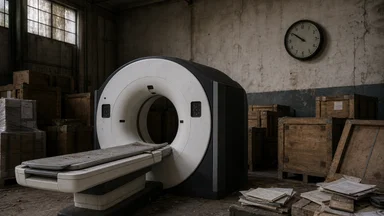
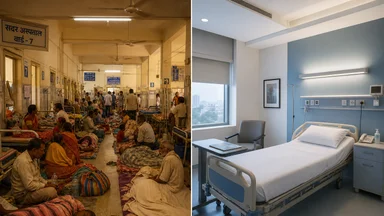
On a Tuesday morning at the Institute of Mental Health in Chennai, the wards are packed. Patients sleep on mats in corridors. The hospital runs at roughly 120% occupancy, with an average stay of four to six weeks for severe mental illness. Across town, a private psychiatric unit at a corporate chain like Fortis or Apollo reports occupancy rates near 50–60%. The beds are clean, the staff attentive, but many rooms are empty. This is the geography of mental health care in India: two systems, serving two versions of the same illness.
Two Indias, One Diagnosis
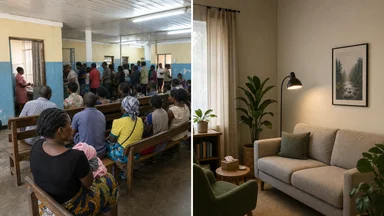
Depression is diagnosed in both public and private settings, but the path a patient takes depends less on clinical need than on insurance status and severity. Public hospitals, by design, admit only severe cases—those with psychosis, suicide risk, or profound functional impairment. Milder forms of depression are turned away or referred to outpatient clinics that are chronically understaffed. Private hospitals, on the other hand, cater to insured patients with mild-to-moderate depression, offering therapy and inpatient detox for substance use disorders.
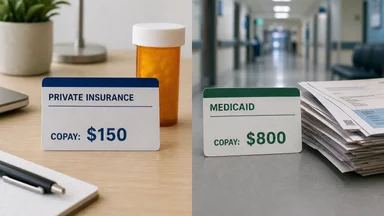
Insurance coverage shapes this divide. Many private plans cover inpatient psychiatric admissions but exclude outpatient therapy or day-care programs. The Insurance Regulatory and Development Authority of India (IRDAI) mandated mental health parity in 2018, but implementation lags. Insurers still cap mental health spending at around 3–5% of the sum insured, and outpatient visits are often excluded. For a patient with moderate depression, paying for therapy out-of-pocket—roughly US$ 15–30 per session—is prohibitive for most.
The tension is stark: severity rules determine who gets a public bed, while ability to pay determines who gets a private one. A patient with moderate depression and no insurance may wait months for an outpatient appointment at a public hospital, while an insured patient with the same severity can get a private room in days. The system treats two versions of the same illness, and the dividing line is not clinical need.
Public Wards Overflow, Private Floors Stay Half-Full
The Institute of Mental Health in Chennai is one of India's oldest and largest public psychiatric hospitals. It serves a population of over 70 million people in Tamil Nadu. The hospital runs at roughly 120% occupancy, with patients often sharing beds or sleeping on the floor. The average stay is four to six weeks, but some patients remain for months due to lack of family support or community-based care options. Staff-to-patient ratios are low, and psychiatrists see upwards of 100 outpatients per day.
Private chains like Fortis and Apollo have dedicated psychiatric units with modern facilities. These units report occupancy rates near 50–60%, according to industry estimates from around 2024. The beds are available, but the patients are not coming—largely because insurance does not cover the full episode of care. A typical private inpatient stay for depression costs roughly US$ 1,000–2,000, out of reach for most Indians without comprehensive coverage.
The empty private beds represent a missed opportunity. If insurance coverage expanded to include outpatient therapy and day-care programs, many patients with moderate depression could be treated in private settings, freeing up public beds for the most severe cases. As it stands, the public system is overwhelmed, and the private system is underutilized—a paradox that policymakers have yet to resolve.
Insurance Exclusions Push Patients to Public Doors
Ayushman Bharat, India's flagship public health insurance scheme, covers only acute psychiatric admissions. Outpatient visits, therapy, and rehabilitation are excluded. This means that a patient with depression who needs ongoing treatment must pay out-of-pocket or seek care at a public hospital. The scheme's design reflects a historical bias toward acute care, but mental health conditions require continuity.
Private insurance plans, while mandated to cover mental health since 2018, often impose caps and exclusions. Many plans limit mental health spending to 3–5% of the sum insured, which translates to roughly US$ 300–500 per year for a typical policy. This is insufficient for even a few therapy sessions or a short inpatient stay. Patients quickly exhaust their coverage and either stop treatment or switch to public facilities.
The result is a two-tier system: insured patients with mild depression may get a few therapy sessions before hitting their cap, while uninsured patients with moderate-to-severe depression crowd into public hospitals. The National Mental Health Survey of India, conducted around 2015–16, estimated that only about 10–15% of people with depression seek help initially. Insurance exclusions are a major barrier, as the cost of care deters many from even starting treatment.
Depression’s Double Burden: Stigma and Cost
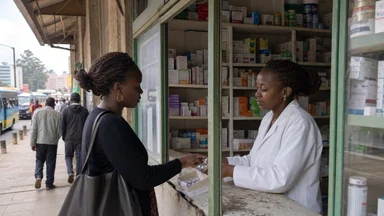
Stigma around mental illness remains pervasive in India. Public hospitals are often seen as a last resort, reinforcing the notion that mental health problems are shameful or incurable. Private care carries lower stigma, but the cost is prohibitive. A course of generic antidepressants at a public pharmacy costs around US$ 2–5 per month, but therapy sessions in private clinics range from US$ 15 to 30 each. For a family earning US$ 200 per month, even one therapy session represents a significant expense.
The double burden of stigma and cost means that many people with depression never seek help at all. Those who do often delay until the condition becomes severe. A 2023 study in The Lancet Psychiatry estimated the treatment gap for depression in India at 85%—meaning only about 1 in 7 people with depression receives minimally adequate care. The gap is wider in rural areas, where mental health services are scarce and stigma is higher.
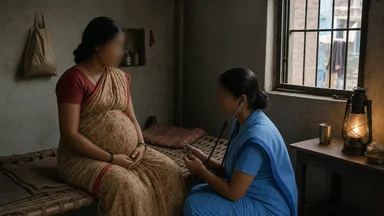
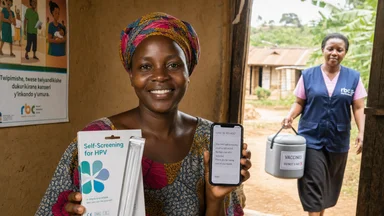
Community health workers, like those in Delhi's maternity programs, have shown promise in reducing stigma and improving access. But mental health-specific initiatives remain underfunded. The government's District Mental Health Programme covers only about 10% of districts, and even in those districts, services are limited to medication and basic counseling. The burden falls disproportionately on women, who face higher rates of depression and greater barriers to care.
A 2023 Study Quantifies the Gap
The Lancet Psychiatry study, published in 2023, provided some of the clearest numbers on the treatment gap. It estimated that only about 1 in 7 people with depression in India receives minimally adequate care. The study defined adequate care as at least four visits to a health provider or a combination of medication and therapy. Public hospitals serve less than 10% of those needing care, while the private sector could absorb 20–30% if coverage expanded.
The study's authors called for mandatory insurance coverage of outpatient psychiatric care, including therapy and day-care programs. They noted that the cost of expanding coverage would be modest compared to the economic burden of untreated depression, which the World Health Organization estimates at over US$ 1 trillion globally per year in lost productivity. In India, untreated depression costs the economy billions of dollars annually.
The study also highlighted the role of tele-psychiatry. During the COVID-19 pandemic, tele-mental health services expanded rapidly, but they remain largely uninsured. A tele-psychiatry session costs roughly US$ 5–10, but without insurance coverage, even that is out of reach for many. The government's eSanjeevani platform offers free tele-consultations, but mental health specialists are scarce on the platform.
What Policy Changes Could Close the Divide
Several policy changes could help close the gap. First, expanding Ayushman Bharat to cover outpatient psychiatric care, including therapy and day-care programs, would reduce the financial barrier for millions. The cost of adding mental health benefits to the scheme is estimated at roughly US$ 0.5–1 per person per year, a small fraction of the total budget.
Second, mandating insurance parity for therapy and day-care programs would align private insurance with clinical need. The IRDAI has taken steps in this direction, but enforcement remains weak. Insurers should be required to cover at least 10–12 therapy sessions per year, with no separate cap on mental health spending.
Third, increasing public hospital funding for mild-to-moderate cases could reduce the burden on tertiary centers. District hospitals could be equipped with basic mental health services, including counseling and medication, to treat depression before it becomes severe. The National Mental Health Survey data should guide bed allocation, ensuring that resources go where they are needed most.
Tele-psychiatry hubs in rural areas can triage severity and provide ongoing care. A hub-and-spoke model, where a central psychiatrist supervises community health workers in multiple villages, has shown promise in pilot programs. Scaling such models could extend care to the roughly 85% of people with depression who currently receive none.
For the Patient, It Comes Down to a Single Number
For a patient with depression, the path to care is determined by a single number: the severity score on a standardized scale like the PHQ-9. A score above 15 may qualify for admission to a public hospital. A score of 10–14, with insurance, may get a private bed. But without insurance, that same score means waiting months for an outpatient appointment, or paying out-of-pocket for therapy that may be unaffordable.
A patient with moderate depression and no insurance waits. They may try to manage on their own, or rely on family support. As symptoms worsen, they may eventually qualify for a public bed—but by then, the illness has taken a toll. Meanwhile, an insured patient with the same severity gets a private room in days, with access to therapy and medication.
The system treats two versions of the same illness. Until policy changes tie coverage to clinical need rather than payer status, the divide will persist. The beds are there, the doctors are trained, the medications are cheap. What is missing is the political will to treat depression as a condition that deserves care at every level of severity—not just at the breaking point.
Trade-offs and Counter-arguments
Some critics argue that expanding insurance coverage for outpatient mental health care could lead to overuse or fraud, driving up premiums for everyone. However, evidence from other countries suggests that mental health parity does not significantly increase overall costs. A 2020 analysis of US parity laws found that total spending on mental health services rose by only about 5% after parity, while access improved substantially. India's current low baseline means that even a doubling of utilization would represent a small absolute increase.
Another counter-argument is that public hospitals should focus on severe cases, and that mild-to-moderate depression is better handled by primary care. But primary care physicians in India are often untrained in mental health, and referral pathways are weak. A 2022 study in the Indian Journal of Psychiatry found that only about 20% of primary care doctors felt confident diagnosing depression, and fewer than 10% offered counseling. Without systemic support, primary care cannot fill the gap.
There is also the question of quality: private hospitals may offer better amenities, but they are not always more effective. A 2021 comparison of outcomes in public versus private psychiatric units in Mumbai found no significant difference in symptom reduction after six weeks, despite the private units having more staff and better facilities. This suggests that the key barrier is access, not quality. The empty private beds are not a sign of inefficiency—they are a sign of an insurance system that fails to connect patients to existing capacity.
Finally, some argue that tele-psychiatry is a panacea, but it has limitations. Internet penetration in rural India is still around 40–50%, and many patients lack smartphones or data plans. A 2023 pilot in Madhya Pradesh found that only about 30% of referred patients completed a tele-consultation, with the rest citing technical difficulties or privacy concerns. Tele-psychiatry is a tool, not a replacement for in-person care, and it works best when integrated with community health workers who can provide hands-on support.
Regional Disparities: Kerala vs. Bihar
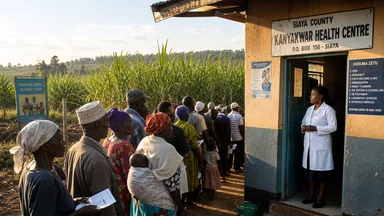
India's mental health divide is not just between public and private—it is also geographic. Kerala, with a high literacy rate and strong primary health infrastructure, has a relatively low treatment gap for depression, estimated at around 60–65% in recent surveys. The state's mental health program covers all districts, and community-based rehabilitation centers are common. In contrast, Bihar's treatment gap is estimated at over 90%, with fewer than 5% of districts covered by the District Mental Health Programme. Public hospitals in Bihar are severely understaffed, with a psychiatrist-to-population ratio of roughly 1:2 million, compared to 1:100,000 in Kerala.
Private hospitals in Bihar are concentrated in urban centers like Patna, leaving rural populations with no options. A 2022 study in the Journal of Mental Health Policy and Economics found that patients in Bihar traveled an average of 80–100 kilometers to reach the nearest psychiatrist, compared to 20–30 kilometers in Kerala. The cost of travel and lost wages often exceeds the cost of treatment itself, creating an additional barrier.
One example is the district of Gaya in Bihar, where a public psychiatric outpatient clinic serves roughly 200 patients per month, but waiting times for a first appointment can exceed three months. Many patients drop out before being seen. In contrast, the private sector in Patna sees patients within a week, but at a cost of roughly US$ 20–40 per consultation—prohibitive for a family earning US$ 100–150 per month. The regional divide mirrors the national one, but with even starker consequences in states with weaker health systems.
The Role of Community-Based Models
Community-based mental health models offer a way to bridge the gap without relying solely on hospitals. In the state of Gujarat, the NGO Sangath has piloted a program where lay counselors deliver evidence-based therapy for depression in primary care clinics. A 2023 randomized trial published in JAMA Psychiatry found that patients who received the intervention had a 50–60% reduction in depressive symptoms after six months, compared to 20–30% in the control group. The cost per patient was roughly US$ 30–50, a fraction of private therapy costs.
Similarly, the government's National Health Mission has begun training Accredited Social Health Activists (ASHAs) to identify and support people with depression in rural areas. However, ASHAs are already overburdened with maternal and child health tasks, and mental health training is often superficial. A 2022 evaluation in Uttar Pradesh found that only about 10–15% of ASHAs could correctly identify symptoms of depression after a two-day training. Scaling such programs requires sustained investment and supervision.
Another promising model is the use of peer support groups. In Tamil Nadu, the nonprofit Banyan has established community-based recovery centers where people with mental illness live in small group homes and receive support from trained peers. A 2021 study found that participants had significantly lower rates of hospitalization and higher quality of life compared to those in institutional care. However, such models remain rare and underfunded.
Conclusion: A System at a Crossroads
India's mental health system is at a crossroads. Public hospitals are overwhelmed, private beds are empty, and millions of people with depression receive no care at all. The divide is not inevitable—it is the result of policy choices that prioritize acute care over continuity, and that tie access to insurance status rather than clinical need. Expanding insurance coverage, investing in community-based models, and strengthening primary care could close the gap. But these changes require political will and a recognition that depression is not a disease of severity alone—it is a condition that deserves care at every level.
This article is for informational purposes only and does not constitute medical advice. Individuals experiencing symptoms of depression should consult a qualified healthcare professional.