UK Spirometry Rates Drop as GPs Diagnose Asthma by Symptom History Alone
Asthma diagnosis in UK general practice is increasingly a matter of history-taking rather than objective measurement. Spirometry rates have fallen by roughly 15% since 2020, and some estimates suggest that over 60% of new asthma diagnoses now rely on symptom history alone. This shift away from guideline-recommended testing has prompted concern among respiratory specialists, who warn that misdiagnosis rates may exceed 30% in some primary care trusts. For a condition that affects roughly 5.4 million people in the UK, the consequences of diagnostic error are substantial.
The Rise of Symptom-Only Asthma Diagnosis
National Institute for Health and Care Excellence (NICE) guidelines have long emphasised the need for spirometry to confirm airflow obstruction before labelling a patient with asthma. Yet in practice, many GPs now bypass the test. A 2024 survey of GP practices in England found that just over a third had access to calibrated spirometry equipment on site, and fewer than half had a staff member trained to perform the test to British Thoracic Society standards.
Time pressure is a major driver. A typical GP appointment lasts 10 minutes, and performing spirometry—including reversibility testing—can take 20 to 30 minutes. For clinicians juggling 30 or more consultations a day, the decision to rely on a wheeze history and a trial of inhaler often seems pragmatic. As one GP in Manchester told me, “If I send every suspected asthma patient for spirometry, I’ll never clear my queue.”
The COVID-19 pandemic worsened the trend. Spirometry was suspended for much of 2020 and 2021 due to infection risk, and recovery has been slow. Many practices never reinstated routine testing. Telemedicine consultations, which became common during the pandemic, rarely include objective lung function assessment. A patient reporting nocturnal cough and wheeze may receive a remote diagnosis and a prescription for a salbutamol inhaler without ever blowing into a machine.
Financial pressures on primary care networks have also contributed. Spirometers cost several thousand pounds, and calibration services add recurring expense. Some clinical commissioning groups have deprioritised spirometry in favour of other diagnostic tools, such as blood tests for allergic sensitisation, which are easier to perform but do not confirm reversible airflow obstruction.
Diagnosis now depends heavily on symptom questionnaires. Tools like the Asthma Control Test and the Asthma Quality of Life Questionnaire have moderate sensitivity but low specificity for confirming the diagnosis. Wheeze and nocturnal cough, two of the most commonly cited symptoms, are poor predictors of reversible obstruction. A patient with undiagnosed COPD or vocal cord dysfunction may be mistakenly labelled as asthmatic.
Why Spirometry Matters for Asthma Management
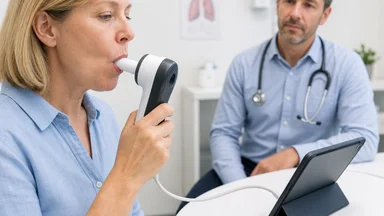
Spirometry measures the forced expiratory volume in one second (FEV1) and forced vital capacity (FVC). An FEV1/FVC ratio below 0.7 after bronchodilator administration suggests persistent airflow obstruction, a hallmark of asthma and COPD. Reversibility testing—repeating spirometry 15 minutes after inhaling a short-acting beta-agonist—adds diagnostic confidence. A 12% and 200 mL improvement in FEV1 is considered a positive response.
Without these objective data, asthma and COPD are frequently confused. Both conditions cause breathlessness and wheeze, but their pathophysiology and treatment differ. Asthma is primarily an inflammatory condition with reversible obstruction, while COPD involves fixed airway narrowing due to smoking or environmental exposures. Overlap syndromes, known as asthma-COPD overlap (ACO), require careful characterisation to avoid under- or over-treatment.
Objective lung function also guides severity classification. NICE categorises asthma as intermittent, mild persistent, moderate persistent, or severe based on symptom frequency and lung function. A patient with normal spirometry but frequent symptoms may have poor asthma control or an alternative diagnosis. Conversely, a patient with severely reduced FEV1 but few symptoms may be minimising their limitations.
Incorrect diagnosis leads to inappropriate inhaler prescriptions. A patient with COPD who receives high-dose inhaled corticosteroids may gain little benefit while incurring side effects such as oral thrush and dysphonia. A patient with asthma who is prescribed a long-acting beta-agonist without an inhaled corticosteroid faces an increased risk of severe exacerbation. The UK's prescribing data show that salbutamol inhaler prescriptions rose by 8% between 2020 and 2024, even as spirometry rates fell.
What Happens When Diagnosis Drifts from Objective Testing
When asthma is diagnosed without spirometry, two groups of patients suffer. The first are those with asthma who are undertreated because their obstruction is missed. A patient with mild intermittent asthma may be managed with as-needed reliever alone, but if their FEV1 is persistently low, they may need daily controller therapy to prevent lung function decline.
The second group are those without asthma who receive unnecessary treatment. Inhaled corticosteroids are generally safe, but long-term use increases the risk of osteoporosis, cataracts, and adrenal suppression. Oral thrush and dysphonia affect up to one in three users. Beta-agonists can cause tremor, tachycardia, and hypokalaemia. For a patient with anxiety-related hyperventilation or deconditioning, these drugs provide no benefit and may cause harm.
Unnecessary treatment also wastes NHS resources. The annual cost of asthma prescriptions in England exceeds £1 billion. Some estimates suggest that 10–20% of this spending—roughly £100–200 million—goes toward inhalers for patients who do not have asthma. This figure does not include the cost of unscheduled care for side effects or the opportunity cost of appointments taken up by patients with incorrect labels.
Delayed diagnosis of COPD is another consequence. A patient whose symptoms are attributed to asthma may not receive smoking cessation support, pulmonary rehabilitation, or appropriate bronchodilator therapy. By the time COPD is correctly identified, lung function may have declined irreversibly. A study published in Thorax in 2023 found that patients with COPD who were initially misdiagnosed with asthma had more frequent exacerbations and a lower quality of life at five-year follow-up.
Paediatric populations face similar risks. Children with asthma-like symptoms are often diagnosed on history alone, but conditions such as tracheomalacia, foreign body aspiration, and cystic fibrosis can mimic asthma. A 2022 audit of paediatric asthma diagnoses in Scotland found that 28% of children labelled as asthmatic had no evidence of reversible obstruction on spirometry.
Systemic Barriers to Spirometry Access
The decline in spirometry is not due to a lack of clinical awareness but to systemic barriers that have persisted despite repeated efforts. Equipment access is a primary issue. Many GP practices lack a spirometer that meets the American Thoracic Society/European Respiratory Society standards for accuracy. Calibration syringes, which must be used daily, are often missing or expired.
Trained staff are equally scarce. Spirometry requires a skilled operator to coach the patient through a maximal forced exhalation and to recognise poor technique. Practice nurses who perform the test may have received only a half-day training session. Interpreting the flow-volume loop requires understanding of pattern recognition, and errors in interpretation are common.
Infection control concerns have persisted since the pandemic. Spirometry generates aerosols, and although the risk of SARS-CoV-2 transmission is now low, many practices have not resumed routine testing. Shared lung function laboratories in hospitals impose strict cleaning protocols, limiting throughput. Some patients are unwilling to attend hospital for a test that they perceive as unnecessary.
Telemedicine has become a default for many asthma follow-ups, but remote assessment cannot replace spirometry. Peak flow meters are often used as a surrogate, but peak flow variability is frequently measured incorrectly by patients. Diurnal variation of more than 20% is suggestive of asthma, but many patients record only morning readings or fail to perform the manoeuvre correctly.
Quality standards for spirometry are not uniformly enforced. The Primary Care Respiratory Society publishes guidelines, but there is no mandatory accreditation for practices. Clinical commissioning groups vary in their audit requirements. A 2024 report by the British Lung Foundation found that only 40% of GP practices had a spirometry quality assurance programme in place.
What the Evidence Says About History-Based Diagnosis
Symptom-based diagnosis has been studied extensively, and the evidence is sobering. The European Community Respiratory Health Survey found that among adults with wheeze in the past year, only 30% had demonstrable airway hyperresponsiveness on methacholine challenge. Wheeze is a symptom, not a disease, and can be caused by obesity, deconditioning, or cardiac conditions.
Nocturnal cough, often considered a hallmark of asthma, has a sensitivity of around 60% and a specificity of 70% in primary care populations. The positive predictive value is modest, meaning that many patients with nocturnal cough do not have asthma. Peak flow diaries, despite being recommended in guidelines, have poor reproducibility. A 2021 systematic review found that peak flow monitoring added little diagnostic accuracy over symptom history alone.
Prospective studies consistently show that one-third of symptom-diagnosed asthma cases are wrong. The UK-based Asthma Diagnosis Study, published in 2022, recruited patients who had been diagnosed with asthma in primary care without spirometry. After formal testing, 33% had no evidence of asthma, 20% had COPD, and 10% had other conditions such as bronchiectasis or dysfunctional breathing.
Exhaled nitric oxide (FeNO) testing offers a potential surrogate. FeNO measures airway inflammation and is elevated in eosinophilic asthma. NICE now recommends FeNO as an option for diagnosing asthma in adults and children aged 5 and older. However, FeNO testing is underutilised in primary care. A 2024 survey found that only 15% of GP practices had access to a FeNO device, and many clinicians were unfamiliar with its interpretation.
Current evidence does not favour abandoning objective testing. A diagnostic algorithm that combines symptom history, FeNO, and spirometry achieves a sensitivity of 85% and specificity of 90%, compared with 60% and 70% for history alone. The incremental cost of adding FeNO is modest, and the savings from avoided inappropriate treatment more than offset the expense.
Practical Steps to Reverse the Trend
Reversing the decline in spirometry will require investment in equipment, training, and reimbursement. Portable, disposable spirometers that cost under £200 per unit are now available. These devices connect to a smartphone app and guide the patient through the manoeuvre, reducing the need for operator training. Cloud-based interpretation software can flag abnormal results for clinician review.
Training programmes for practice nurses and healthcare assistants should be expanded. The British Thoracic Society offers a spirometry certification course, but uptake among primary care staff is low. Practices could be incentivised to have at least one certified spirometry operator on site. Refresher training every two years would maintain competence.
Remote spirometry monitoring, where patients perform the test at home under video guidance, has shown promise. A pilot study in Oxfordshire found that home spirometry with remote coaching produced results comparable to clinic-based testing. Widening this approach could reduce the burden on practices and improve access for housebound patients.
FeNO measurement should be integrated into routine asthma diagnostic pathways. The devices are smaller and easier to use than spirometers, and they require minimal patient effort. Including FeNO in the initial assessment could reduce the number of patients who need referral for specialist testing. Some clinical commissioning groups have already adopted FeNO as a first-line test, with encouraging results.
Reimbursement is a critical lever. GPs in the UK are paid through a combination of capitation fees and quality-of-care payments. Adding a specific tariff for spirometry—say, £20 per test—would compensate for the time spent. The experience of other countries shows that financial incentives can rapidly change diagnostic behaviour.
A Call for Diagnostic Discipline in Primary Care
Asthma guidelines must reaffirm the primacy of objective testing. NICE's 2021 update already recommends spirometry as the first-line diagnostic test, but adherence is poor. The next iteration should include specific benchmarks, such as a target that 80% of new asthma diagnoses be confirmed by spirometry within 12 months. Clinical commissioning groups should audit diagnosis rates against spirometry use and publish the results.
Patients should be educated to request a confirmatory test. Many individuals accept an asthma diagnosis without question, not realising that the label has implications for insurance, employment, and lifestyle. A simple patient information leaflet explaining the importance of spirometry could empower people to ask, “Have I had a breathing test?”
Specialist referral thresholds need tightening for equivocal cases. When spirometry is normal but symptoms persist, referral for bronchial provocation testing or FeNO measurement should be considered. Conversely, when spirometry shows fixed obstruction, referral for COPD management should be prompt. The current system often leaves these patients in diagnostic limbo.
Spirometry remains the single most cost-effective diagnostic tool for asthma. A 2023 health economics analysis estimated that each spirometry test performed saves the NHS roughly £150 over five years by preventing unnecessary treatment and reducing exacerbations. The upfront cost of equipment and training is recouped within two years. For a health system under financial strain, the case for investment is clear.
The decline in spirometry is not inevitable. With targeted investment, training, and reimbursement, primary care can restore diagnostic discipline. The alternative—continuing to diagnose asthma by symptom history alone—risks harming patients and wasting resources. The choice is not between speed and accuracy; it is between a system that works and one that does not.
This article is for informational purposes only and does not constitute personalised medical advice. Readers should consult a qualified health professional for diagnosis and treatment of respiratory conditions.